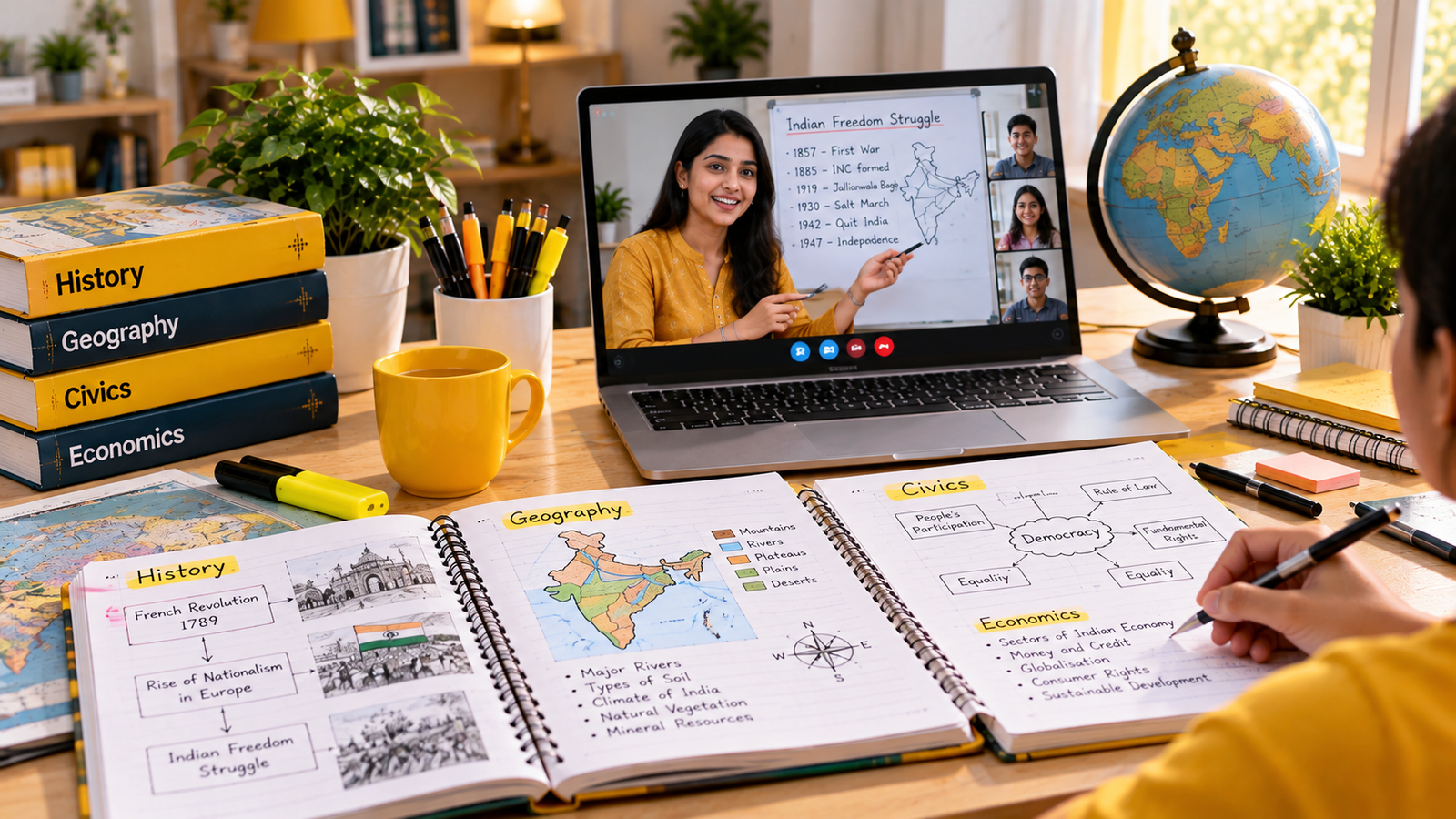
Class 12 requires students to move beyond memorising notes and demonstrate accurate understanding, application and clear communication. An online tutor for Class 12 Geography can help organise learning around the student’s current syllabus, strengths, gaps and examination schedule. This guide explains how to plan lessons, practise effectively and measure progress without relying on unrealistic promises.
The Infinity Home Tuitions supports online learning enquiries for students and families. Confirm the exact board, subject code, prescribed materials and assessment requirements with the school before starting. The examples below are learning strategies, not a substitute for the official syllabus.
Build a syllabus-aligned starting plan

Confirm the student’s board, subject/course code, prescribed materials and school assessment plan before setting a timetable. Begin with a short diagnostic task covering human geography, population, human development, economic activities, transport, communication, resources, environmental issues, data interpretation and map work. Its purpose is to find gaps and strengths rather than assume every chapter needs equal time.
Ask the learner to explain an answer aloud, complete a representative question and describe where uncertainty began. For Geography, this reveals whether the difficulty is conceptual understanding, terminology, working method, writing structure or time management.
Record recent marks, topics already taught, pending chapters, confidence level and upcoming school tests. This information helps select the first lessons around high-impact gaps and prevents unnecessary repetition of content the student already understands.
Use the latest official curriculum and school instructions rather than relying on old notes or generic online material. The tutor should clearly flag anything that needs confirmation against the current subject document.
End the diagnostic session with two or three measurable priorities, such as explaining a concept independently, completing a representative task accurately or improving answer structure. Review those priorities after several lessons.
Develop connected subject understanding

Students often memorise notes without understanding how ideas connect. Build a concept map linking key terms, processes, examples and consequences within human geography, population, human development, economic activities, transport, communication, resources, environmental issues, data interpretation and map work. When the learner can explain those links in their own words, they are better prepared for unfamiliar questions.
Use a short explanation, a worked example and then an independent attempt. In Geography, model the reasoning behind interpreting a map, table or distribution pattern and explaining the geographical reasons behind it; next, let the student solve a parallel task while explaining each decision. This makes misconceptions visible early.
Maintain a concise notebook with definitions, methods, diagrams or examples where relevant, and common mistakes. Notes should support retrieval and practice, not become a substitute for active problem solving.
Connect abstract ideas to familiar situations without losing technical accuracy. Distinguish the simplified example from the formal definition and return to the exact language expected in school assessments.
Finish with a retrieval check: ask the learner to summarise the idea without notes, answer a short question and identify one unresolved point. Revisit that point before introducing too much new content.
Practise questions that match the assessment

Practice should reflect question types, marks, command words and timing in the student’s current syllabus. Students should distinguish instructions such as define, explain, compare, analyse, evaluate, calculate or justify because each requires a different depth and structure.
A question built around interpreting a map, table or distribution pattern and explaining the geographical reasons behind it may require a definition, application and conclusion. Model how to allocate time and marks, then let the student try independently. A worked answer helps only when the learner understands why each step is relevant.
Start untimed to establish accuracy, then introduce time limits gradually. Review whether the student misunderstood the prompt, omitted a required point, used weak evidence, made an execution error or spent too long on one part.
Use a mix of short-answer, long-answer, source-based, case-based, numerical, practical, map or diagram tasks as appropriate to Geography. Balanced coverage is necessary to reveal gaps across the syllabus.
After each set, record the topic, error type, likely cause and prevention step. Revisit recurring errors in the next lesson so practice leads to improvement rather than simply a higher question count.
Improve terminology and answer structure

Precise subject language helps students communicate understanding. Create a glossary for human geography, population, human development, economic activities, transport, communication, resources, environmental issues, data interpretation and map work with a clear meaning, a suitable example and a sentence showing how each term is applied. Practise using technical vocabulary accurately instead of inserting terms where they do not fit.
Teach a dependable written-response structure: answer directly, develop the key point, add evidence or an example where appropriate, and conclude if the task requires it. The length should match the marks and command word, not a fixed preference for long answers.
For Geography, a strong response to interpreting a map, table or distribution pattern and explaining the geographical reasons behind it makes the reasoning explicit. Underline the command word, circle the central concept and plan two or three points before writing. This reduces repetition and improves clarity.
Feedback should identify a specific improvement. Show how to replace a vague statement with an accurate explanation, add a missing step or organise ideas in a clearer sequence. Then ask the learner to rewrite the answer.
Before submitting work, check relevance, terminology, units or labels where applicable, grammar, calculations and whether every part of the question has been answered. A short checklist is easier to use consistently than general reminders.
Make online lessons interactive

An effective online class is not a long video call. Use a digital board, annotated examples, guided questions and live student attempts. Learners should frequently explain, attempt, correct and retry rather than only watch the tutor solve problems.
Keep technology simple: stable internet, a charged device, notebook and access to prescribed materials. If a connection fails, the learner should still know which task to complete and how to send work for feedback.
For Geography, demonstrate a task based on interpreting a map, table or distribution pattern and explaining the geographical reasons behind it, then ask the student to complete a similar task. Avoid doing all the thinking for them; asking the learner to predict the next step gives a clearer view of understanding.
One-to-one lessons can adapt quickly to individual gaps, while a small group may support discussion and alternative approaches. The right format depends on pace, confidence, need for feedback and ability to participate.
End every session with the topic covered, skill demonstrated, remaining question and homework task. This summary helps the learner restart efficiently and lets parents understand the process.
Plan weekly revision and retrieval

A realistic plan divides the syllabus into new learning, guided practice, retrieval, timed questions and review. Shorter, regular sessions are usually easier to sustain than leaving revision to the final weeks. Account for school, other subjects, sleep and existing workload.
A weekly rhythm might include concept lessons, independent practice blocks, mixed questions and a short review of mistakes. Adjust the balance for Geography and the student’s actual gaps rather than imposing one timetable on every learner.
Use spaced revision: revisit a topic after a day, several days later and again in a mixed practice set. This helps students retrieve information when a question does not announce which chapter it belongs to.
After finishing a unit, include earlier topics in a new practice set instead of treating them as permanently completed. This is useful for connecting ideas across human geography, population, human development, economic activities, transport, communication, resources, environmental issues, data interpretation and map work and finding gaps hidden by chapter-by-chapter study.
Review the plan each week using accuracy, completion time, mistake types and confidence explaining concepts. If progress stalls, change the teaching method or revisit prerequisites instead of only adding more homework.
Measure progress with evidence

Measure progress through observable skills rather than vague promises of high marks. Compare baseline and follow-up tasks, track repeated errors and note whether the learner can solve questions independently. One test score alone may not represent the full picture.
A simple tracker can include topic, practice date, accuracy, time taken, confidence and next action. For Geography, note how the student handled interpreting a map, table or distribution pattern and explaining the geographical reasons behind it; this gives the tutor a practical basis for choosing the next lesson.
Parents should receive concise updates about what improved, what remains difficult and which practice will help. Avoid unsupported guarantees: outcomes depend on starting point, attendance, syllabus coverage, effort and assessment conditions.
A mock test is useful when it matches the current syllabus and is followed by detailed analysis. Categorise each lost mark and redo selected questions after feedback. Taking tests without reviewing mistakes is inefficient.
Celebrate specific behaviours: completing practice consistently, explaining a difficult idea clearly, reducing a recurring error or managing time better. These indicators focus attention on actions the learner can control.
Avoid common preparation mistakes

Passive rereading can feel productive without revealing whether the student can retrieve and apply information. Close the book, answer from memory, explain the concept aloud and then check accuracy to see what is actually understood.
Avoid relying on predictions or selective study. Prioritise the official syllabus, school guidance and performance data. Rumours about likely questions should never replace balanced preparation across required learning outcomes.
Do not copy model answers without learning how they are built. Use examples to identify structure, then answer a different question independently. In Geography, practise transferring the same idea to a new context such as interpreting a map, table or distribution pattern and explaining the geographical reasons behind it.
Last-minute cramming leaves little time to correct errors or consolidate earlier topics. A weekly review and short daily retrieval task can reduce pressure. If the learner falls behind, reset priorities instead of building an unrealistic timetable.
Classify mistakes as missing knowledge, misunderstanding, careless execution, weak expression or poor time allocation. Each cause needs a different remedy, and a tutor should help choose the right one.
Support learning as a parent

Parents can provide a regular study space, accessible materials and a realistic schedule. The student should still take responsibility for attempting tasks and asking questions; constant supervision can interfere with independent study habits.
Ask for concrete updates: which skill was practised, what the student can now do independently, what remains difficult and what is expected before the next lesson. This is more useful than asking only whether the class went well.
Share upcoming assessments, teacher feedback or syllabus changes promptly. If the student feels overwhelmed, discuss workload and priorities before adding extra classes or homework.
Invite the student to explain one idea from the lesson and show one corrected mistake. This is a useful retrieval exercise and lets parents notice progress without needing subject expertise.
A productive arrangement is collaborative: the tutor provides instruction and feedback, the student practises consistently, and parents help maintain conditions for learning. Clear responsibilities make adjustments easier.
Choose the right tutor and lesson format

Ask whether the tutor has experience with the exact class, board and subject. Subject knowledge matters, but so does the ability to explain difficult ideas, diagnose misconceptions and adapt to the learner’s pace.
Ask how lessons are structured, how practice is checked and how progress is reported. A credible plan includes active student work, feedback, revision and review. Be cautious of promises that guarantee marks without first assessing the learner.
Confirm lesson length, schedule, fees, cancellation arrangements and resources before committing. The student should know what to bring and how homework will be submitted or reviewed between sessions.
For Geography, ask how the tutor will teach human geography, population, human development, economic activities, transport, communication, resources, environmental issues, data interpretation and map work and support practice on interpreting a map, table or distribution pattern and explaining the geographical reasons behind it. A useful answer describes a practical method, not just a list of chapters or a promise to finish the syllabus quickly.
After a few lessons, evaluate participation, clarity, feedback quality and independent work. If the approach is not helping, discuss specific changes early rather than waiting until the exam period.
Prepare for the final revision phase

As exams approach, shift from introducing new content toward consolidating concepts, mixed questions and timing. The balance depends on syllabus completion and the learner’s gaps; do not rush into mock tests while foundational understanding is unstable.
Create a checklist for topics in human geography, population, human development, economic activities, transport, communication, resources, environmental issues, data interpretation and map work. Mark each secure, needs practice or needs teaching, and update it after review. This makes revision decisions more rational than repeatedly studying favourite chapters.
Use timed papers when the student has enough syllabus coverage to benefit. Analyse errors afterwards, choose high-value corrections and redo selected questions. Protect time for rest, meals and sleep, which support concentration and recall.
On the day before a test, focus on concise notes, key terms, formulas where relevant, examples and previously corrected errors. Avoid trying to learn every topic from scratch overnight.
After each exam, record what worked and what needs adjustment for the next paper. The goal is a repeatable preparation method that supports long-term learning, not simply getting through one test.
Frequently asked questions about a Class 12 Geography tutor
Is online tutoring suitable for Class 12?
It can work well when lessons are interactive, the tutor follows the student’s actual syllabus and the learner completes independent practice. Device access and a consistent schedule also matter.
How often should lessons happen?
Frequency depends on baseline knowledge, school timetable, remaining syllabus and assessment dates. Agree on a realistic plan after a diagnostic session and review it using progress evidence.
Can a tutor guarantee board exam marks?
No responsible tutor can guarantee a particular score. Outcomes depend on prior knowledge, syllabus coverage, attendance, practice and exam conditions.
What should parents share before the first class?
Share the board, subject/course name, current syllabus, prescribed materials, recent school feedback, upcoming tests and the student’s main difficulties.
How can progress be checked?
Compare baseline and follow-up questions, review recurring errors, check independent work and track accuracy and timing. Ask what improved and what the learner should practise next.
Enquire about online tuition
Share the student’s class, board, subject, current learning goals and preferred schedule. Visit The Infinity online learning website, download the The Infinity app, or visit the WhatsApp channel. Confirm tutor availability, fees and lesson format directly before booking. For CBSE, consult the current official curriculum at CBSE Academic; other boards should use their own official syllabus.