Looking for an Online Maths Tutor? The Infinity Home Tuitions helps students explore live online mathematics learning through one-to-one tuition and group live classes. Lessons can be planned around the learner’s class, curriculum, current chapters, learning pace and examination goals. Whether the challenge is understanding algebra, drawing geometry diagrams, practising trigonometry or revising calculus, a structured lesson plan can make study more focused.
Before choosing a tutor, share the student’s class, board, topics requiring support, preferred class format and available timings. This helps match the learning plan to the actual syllabus rather than using a generic approach.
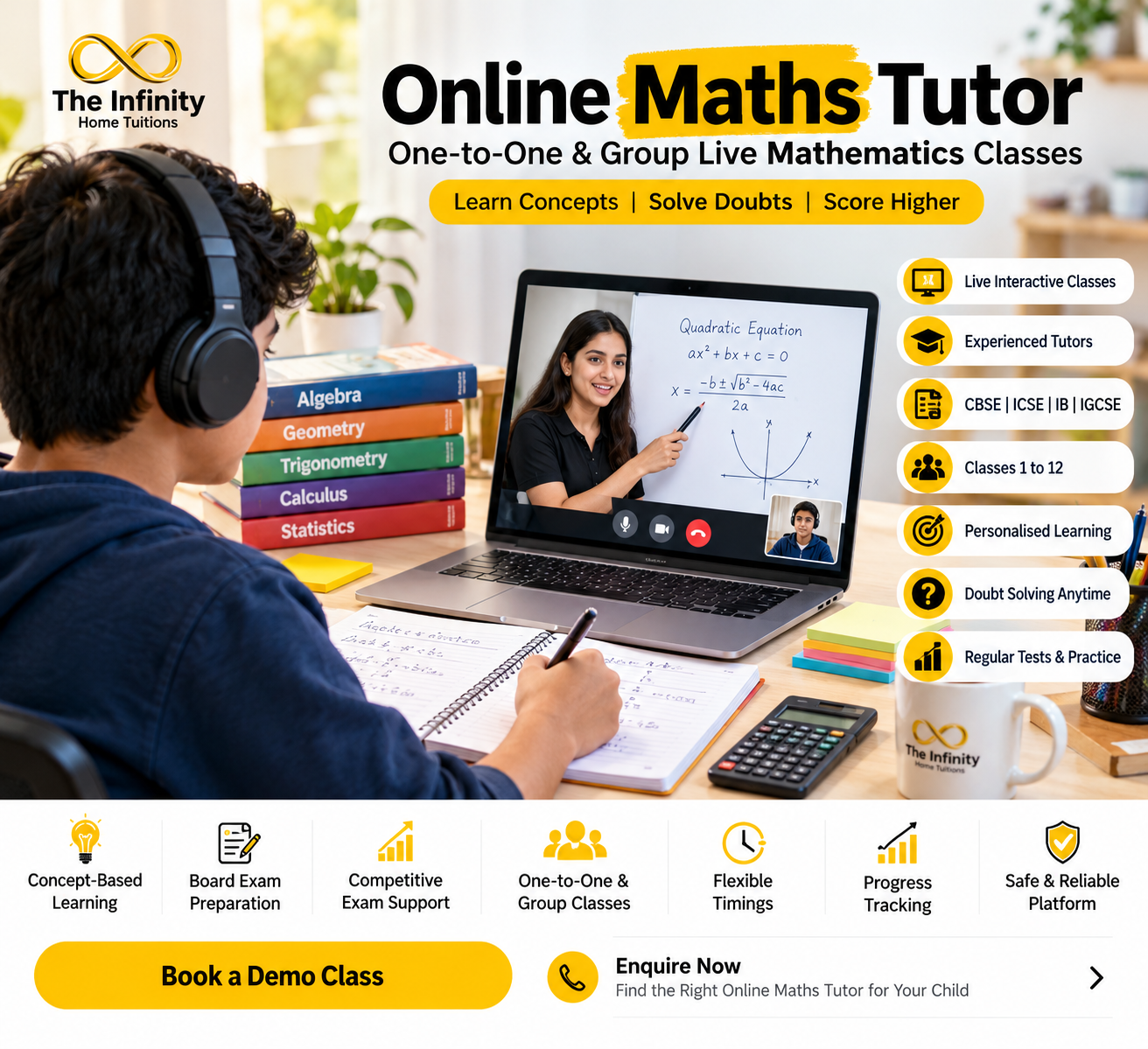
Online Maths Tutor for Personalised Learning
Mathematics is cumulative: later topics often depend on earlier skills. A student who is unsure about fractions may struggle with algebraic fractions; weak equation-solving can affect coordinate geometry; and gaps in functions can make calculus more difficult. An online maths tutor can identify these prerequisite gaps and address them in a logical sequence.
Effective tutoring involves more than showing the answer. The student should understand why a method works, when to use it, how to show each step and how to check the final result. Lessons can include explanation, worked examples, guided practice, independent questions, homework review and regular revision.
One-to-One Online Maths Classes
One-to-one online tuition gives a learner individual attention during the lesson. The tutor can adjust the pace, choose examples at the right level and revisit a difficult concept without holding back or rushing the student.
- Individual lesson plan: focus on the student’s syllabus and priority topics.
- Step-by-step explanations: break complex questions into manageable stages.
- Direct doubt solving: ask questions as soon as a step becomes unclear.
- Targeted practice: work on the question types that need improvement.
- Progress checks: use short quizzes and review of mistakes to guide the next lesson.
This format may suit learners who have missed foundational concepts, need additional practice, prefer a quieter learning environment or want support alongside school classes.
Group Live Online Mathematics Classes
Group tuition offers structured lessons and opportunities to learn with other students. Learners can hear different approaches, discuss solutions and practise common question types together. Group classes may be a good fit for students who enjoy peer interaction and a regular timetable.
For group learning to be useful, the level and curriculum should be reasonably aligned. Ask about the group size, lesson schedule, doubt-solving process, practice material and how individual progress is monitored before enrolling.
Maths Topics Covered by an Online Tutor
Topics depend on the student’s grade and curriculum. Primary-level lessons may focus on number sense and arithmetic, while senior-secondary classes can include functions, calculus and probability. Tutoring should follow the student’s prescribed syllabus and avoid introducing advanced topics before the foundations are secure.
- Numbers, place value, fractions, decimals and percentages
- Ratios, proportions, averages and word problems
- Integers, exponents, algebraic expressions and equations
- Geometry, constructions, mensuration and coordinate geometry
- Polynomials, sequences, functions and graphs
- Trigonometry and identities
- Statistics, data handling and probability
- Limits, continuity, differentiation and integration where prescribed
- Vectors and three-dimensional geometry where prescribed
Online Maths Tutor for Classes 1 to 5
At primary level, confidence grows when children understand what numbers represent instead of memorising procedures alone. Lessons can cover place value, addition, subtraction, multiplication, division, tables, fractions, money, measurement, time, shapes and simple word problems.
A tutor can use drawings, number lines, everyday examples and short practice sets to make abstract ideas easier to understand. Children should be encouraged to explain their thinking, estimate an answer and check whether the result makes sense. Short, consistent practice is usually more productive than a long session filled with repetitive questions.
Online Maths Tutor for Classes 6 to 8
Middle-school mathematics develops more formal reasoning and introduces concepts that support secondary-school work. Depending on the syllabus, topics may include integers, fractions, decimals, ratios, percentages, rational numbers, algebraic expressions, linear equations, exponents, geometry, mensuration, data handling and introductory probability.
Students should practise showing complete working, using mathematical notation correctly and explaining why a step is valid. If a learner repeatedly makes the same error, the tutor can revisit the underlying concept rather than asking the student to memorise another shortcut.
Online Maths Tutor for Classes 9 and 10
Classes 9 and 10 can be important for building a strong foundation for senior-secondary mathematics and competitive examinations. Depending on the board, tutoring may cover polynomials, linear equations, number systems, coordinate geometry, triangles, circles, surface areas and volumes, trigonometry, statistics and probability.
Sessions can include theorem-based reasoning, construction of diagrams, formula selection, multi-step problems and timed practice. Students should learn to read each question carefully, identify the information given, select a suitable method and present the solution clearly. Revision plans should prioritise both difficult chapters and topics where small errors regularly cost marks.
Online Maths Tutor for Classes 11 and 12
Senior-secondary mathematics often requires consistent practice and a sound grasp of prerequisites. Depending on the course, topics can include sets, relations and functions, trigonometric functions, complex numbers, quadratic equations, sequences and series, permutations and combinations, binomial theorem, coordinate geometry, limits, derivatives, integrals, differential equations, vectors, three-dimensional geometry, linear programming and probability.
A tutor can help students connect concepts across chapters, work through textbook examples and practise examination-style questions. For calculus, for example, learners need to understand functions and algebraic manipulation as well as the rules of differentiation and integration. For coordinate geometry, accurate diagrams and interpretation of equations can be just as important as arithmetic.
Exam preparation should combine chapter-wise practice with mixed-topic questions. Timed papers help students practise choosing an approach efficiently, while reviewing errors helps distinguish a conceptual gap from a calculation or presentation mistake.
Support for CBSE, ICSE/ISC, IB, IGCSE and Cambridge
Different boards and curricula use different syllabuses, terminology and assessment styles. A suitable online maths tutor should first establish the student’s board, grade, course level and prescribed topics. The learning plan can then be aligned with school material, curriculum objectives and upcoming assessments.
For international curricula, students should share the exact course or level rather than only the board name. For all curricula, use the prescribed textbook and teacher guidance as the reference point for syllabus coverage. Additional worksheets should support those objectives rather than distract from them.
How Live Online Maths Tuition Works
A typical lesson starts with a short recap or retrieval question. The tutor introduces the concept, demonstrates a worked example and explains the reasoning behind each step. The student then solves a similar question with guidance and attempts another independently. The session can finish with a short summary and a focused practice task.
Students generally need a suitable device, stable internet access, notebook, pen and the relevant textbook or worksheet. Screen sharing and a digital whiteboard can support equations, graphs and geometry diagrams. Learners should keep their working visible so the tutor can identify exactly where an error occurs.
Homework, Tests and Revision
Independent practice is essential because understanding a demonstration does not automatically mean a student can solve a new question alone. Short homework assignments can reinforce the lesson and reveal which skills need another explanation.
Progress checks can include quick quizzes, chapter tests, mixed-topic worksheets and timed practice. A useful review records the type of error, such as misunderstanding the question, choosing the wrong formula, making an algebraic slip or failing to show reasoning. The student can then practise the specific skill needed to prevent that error from recurring.
Choosing Between One-to-One and Group Classes
One-to-one tuition is often suitable when a learner needs a personalised pace, focused remedial support or direct attention to specific weaknesses. Group classes may be suitable for learners who benefit from discussion, shared practice and a regular group schedule. Neither format is automatically best for every student; the choice depends on learning needs, confidence, schedule and available options.
How to Choose the Right Online Maths Tutor
- Confirm the tutor’s familiarity with your class, board and syllabus.
- Explain the chapters that are difficult and the goals you want to achieve.
- Ask how lessons, homework and revision are structured.
- Find out how the tutor checks understanding rather than only completing questions.
- Confirm class length, timings, fees, group size where relevant and missed-class arrangements.
- Review progress periodically and adjust the plan when needed.
How Parents Can Support Online Maths Learning
Parents can help by arranging a quiet study space, checking that the device and internet are ready, and encouraging a regular practice routine. Instead of focusing only on marks, ask the student to explain what was learned and which question type still feels difficult. This can help identify where extra support is needed.
Consistent communication between the student, parent and tutor makes it easier to respond to changing school requirements. Share upcoming tests, syllabus changes and teacher feedback so lessons remain relevant.
Common Maths Learning Problems and How Tuition Can Help
Memorising formulas without understanding: connect each formula to a worked example and practise identifying when it applies.
Careless calculation errors: show intermediate steps, estimate the likely answer and check signs, units and arithmetic.
Difficulty starting a question: identify what is given, what must be found and which concept links the two.
Forgetting previous chapters: use spaced revision and mixed-topic questions instead of studying each chapter only once.
Exam-time pressure: practise under timed conditions and review which steps consume too much time.
Online Maths Tuition for Students in India and Abroad
Online learning can connect students with tutors without requiring travel. Students in India and international learners in countries such as Australia, New Zealand, the United States, Canada, the United Kingdom and the UAE can enquire about suitable online arrangements. Tutor availability, curriculum familiarity and time-zone compatibility should be confirmed before classes begin.
When enquiring, mention the student’s location and time zone, grade, board, current topics and preferred schedule. This information helps determine whether a suitable learning arrangement is available.
Frequently Asked Questions About Online Maths Tutors
Can I learn mathematics effectively online?
Yes. Live lessons can include explanation, worked examples, interactive problem solving, homework review and feedback. Regular independent practice remains important.
Is one-to-one online maths tuition available?
The Infinity Home Tuitions provides online tuition options. Contact the team to confirm current tutor availability for your class, board and schedule.
Can an online maths tutor help with exam preparation?
A tutor can help organise syllabus revision, practise exam-style questions, review mistakes, improve solution presentation and build familiarity with timed papers.
Which classes and boards can be supported?
Support can be discussed for different grades and curricula, subject to tutor availability. Share the student’s exact class, board and syllabus to identify a suitable match.
What should I prepare before an online class?
Keep a device, stable internet, textbook or syllabus, notebook and questions ready. Ask the tutor whether any additional software or learning materials are required.
How often should a student attend online maths classes?
The appropriate frequency depends on the student’s goals, existing understanding, school workload and examination timeline. Discuss these factors with the tutor before deciding on a schedule.
Are group classes suitable for every student?
Group classes can work well for learners who benefit from peer interaction and a shared pace. Students who need intensive individual support may prefer one-to-one tuition.
Start Learning with an Online Maths Tutor
Need help with school mathematics, chapter revision or exam preparation? Contact The Infinity Home Tuitions to discuss the student’s class, board, current topics and preferred learning format for one-to-one online maths classes or group live mathematics classes.
Explore Online Tuition Services or visit The Infinity Home Tuitions to enquire about available learning options. For curriculum reference, students may also consult NCERT where applicable.