Looking for a online civics tutor for class 7? This parent-and-student guide explains how to plan lessons, practise core skills and prepare for school assessments. The most useful tuition plan follows the learner’s actual board, textbook and school syllabus rather than assuming every school covers the same chapters in the same order.
What Class 7 learning requires
Class 7 is an important transition: students are expected to explain their reasoning, apply ideas in unfamiliar examples and organise their work more independently. A useful Civics learning plan begins with the student’s current school syllabus, recent classwork and the exact points that feel difficult. The tutor should confirm the board, textbook, school pace and assessment format before setting a plan. This avoids teaching ahead in a way that conflicts with classroom terminology or overlooking foundational gaps.
Core concepts and syllabus alignment
Depending on the school and board, important areas may include equality, government, public services, media, markets, gender, local institutions, rights, responsibilities and examples from everyday life. This list is a planning guide rather than a universal syllabus: chapter names and sequence vary, so the tutor should check the school’s current syllabus and textbook. For each chapter, identify the learning outcomes, key terms, worked examples, diagrams or writing formats, and the type of questions used in class tests. A simple chapter tracker helps students and parents see what has been taught, practised and revised.
- Review the relevant school chapter and mark doubts.
- Explain the key idea in your own words before checking notes.
- Complete a short independent practice set and record mistakes.
Build understanding before memorising

A learner should be able to describe an idea in their own words before moving to harder questions. In a live lesson, the tutor can model one example, solve a second example together with the student, and then ask the student to attempt a third independently. Asking “why did you choose this step?” reveals whether the learner understands the method or is copying a pattern. Short checks during the session make it easier to correct misconceptions before they become habits.
How one-to-one online tuition works
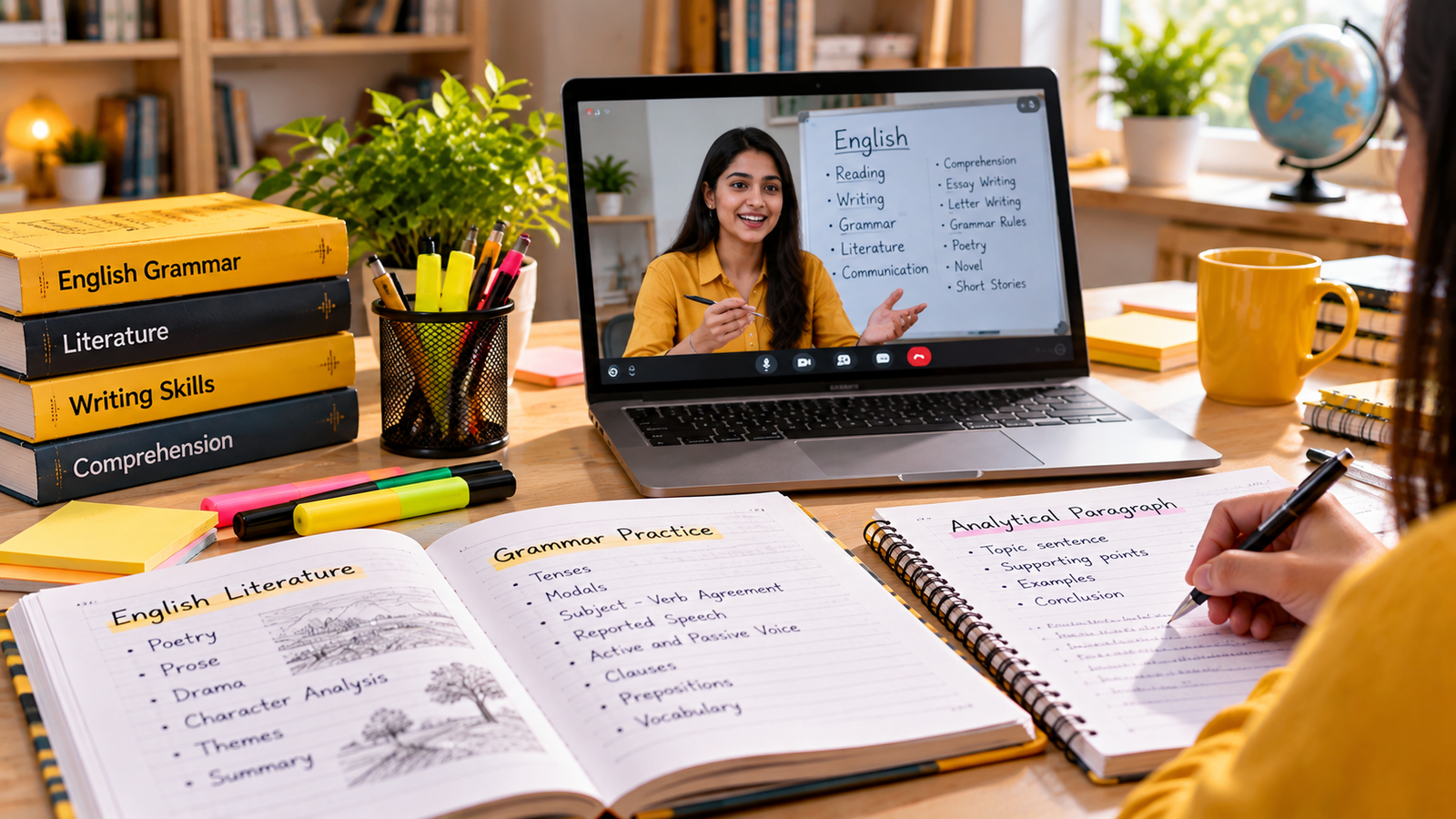
One-to-one online classes can be useful when the student needs a pace that differs from a school lesson. The tutor can share a digital whiteboard, annotate a passage or diagram, demonstrate a process, and ask the learner to explain each step. Students should keep their textbook and notebook nearby and use a stable internet connection. A good session is interactive: the student speaks, writes, solves or demonstrates instead of watching a long lecture without feedback.
Practice methods that make progress visible
Practice should be varied and purposeful. Start with recall questions, move to routine examples, and finish with one or two questions that require transfer to a new situation. For Civics, practice can include equality and media. Keep an error log with three columns: the mistake, why it happened, and the corrected approach. Reattempt similar questions after a day or two; repeated success without hints is a stronger sign of learning than completing a worksheet once.
- Review the relevant school chapter and mark doubts.
- Explain the key idea in your own words before checking notes.
- Complete a short independent practice set and record mistakes.
Common difficulties and how to address them

Students often struggle because several small issues combine: an earlier concept is unclear, instructions are read too quickly, keywords are misunderstood, or the final answer is not checked. The tutor should diagnose the exact point of difficulty rather than simply assigning more work. Ask the learner to think aloud, review a wrong answer step by step and then try a parallel example. If the same problem continues, return briefly to the prerequisite skill and build back up with smaller steps.
A weekly study routine

A manageable weekly routine is more effective than a last-minute rush. Set two or three short independent practice blocks, one lesson for the current school topic, and one brief review of previously taught material. A sample routine is 10 minutes of recall, 25 minutes of focused practice and 5 minutes to record doubts. Adjust this to the child’s school timetable, homework load and energy. The objective is steady understanding, not filling every evening with tuition.
Homework and independent practice

Homework should show what the student can do independently. After a lesson, assign a small set of carefully selected tasks rather than a large repetitive bundle. The learner should attempt them without immediately checking solutions, mark uncertain questions, and bring those questions to the next class. Parents can support by providing a quiet workspace and asking what the student learned, but should avoid doing the work on the student’s behalf. Independent effort gives the tutor accurate evidence of progress.
Revision and memory techniques

For revision, use spaced practice: revisit a topic briefly after one day, again after several days, and once more before an assessment. Create a one-page summary with definitions, rules, formulas, examples or key evidence as appropriate. Close the notes and explain the idea from memory, then check for missing points. Flashcards can help with vocabulary and terms, while mixed-topic practice helps students decide which method fits a question instead of relying on chapter order.
- Review the relevant school chapter and mark doubts.
- Explain the key idea in your own words before checking notes.
- Complete a short independent practice set and record mistakes.
Assessment and exam-answer strategy

Exam performance depends on both knowledge and communication. Students should read command words such as define, compare, explain, calculate or justify carefully. Show working where required, label diagrams, use subject vocabulary, and answer every part of a multi-part question. Leave time to check units, spelling, calculations, grammar or whether the response addresses the prompt. The tutor should use the school’s marking criteria when available and give feedback on specific improvements rather than vague comments like “write better.”
How parents can support learning

Parents can help by sharing recent test papers, teacher feedback and the syllabus with the tutor, then reviewing progress at sensible intervals. Ask for concrete updates: which skill improved, which error still occurs, and what the student should practise next. Avoid comparing the child with classmates or treating every mistake as failure. Confidence grows when goals are specific and achievable, such as explaining a concept clearly or completing a short set accurately without prompts.
Choosing the right online tutor

When choosing an online tutor, look for subject knowledge, age-appropriate explanations, punctuality, clear communication and willingness to adapt to the school’s course. Ask how the tutor diagnoses gaps, checks understanding and reports progress. A trial lesson can show whether the student feels comfortable asking questions and whether the tutor listens carefully. Do not rely only on promises of guaranteed marks; results depend on attendance, practice, school expectations and the student’s starting point.
Questions students should ask

Students should feel comfortable asking questions such as “Can you show another example?”, “Why is this method correct?”, “What is the difference between these two terms?” and “Can I explain it back to you?” These questions turn a lesson into active learning. If an explanation does not make sense, the tutor should try a different representation—an example, diagram, comparison, short demonstration or simpler starting point—rather than repeating the same words louder or faster.
Practice checklist for the month

At the end of each month, check whether the learner can recall the main ideas, solve representative questions independently and explain common mistakes. For Civics, choose a small set covering responsibilities and examples from everyday life, government and markets. Compare the work with the school’s expectations, not with an unrealistic target. If a skill remains weak, revise the prerequisite and adjust the next month’s plan instead of moving on automatically.
- Review the relevant school chapter and mark doubts.
- Explain the key idea in your own words before checking notes.
- Complete a short independent practice set and record mistakes.
Using school resources effectively

The school textbook, class notes, teacher worksheets and official curriculum guidance should remain the primary reference points. External resources can offer another explanation or extra practice, but should not replace the prescribed course or introduce unverified claims. For CBSE-related information, families can consult the official CBSE website at https://www.cbse.gov.in/ and confirm class-specific requirements with the school. The tutor should clearly distinguish required syllabus material from optional enrichment.
Progress tracking without pressure

Track progress with a simple weekly record: topics covered, practice completed, questions answered independently and the next action. Use observable indicators rather than labels such as “weak” or “brilliant.” Examples include “can explain the term without notes,” “needs a reminder to show working,” or “checks the final answer consistently.” This helps the student see improvement and gives parents useful information without turning every study session into a high-pressure test.
Frequently asked questions

Is online tuition suitable for every student? It can work well when lessons are interactive and the learner has a suitable device, internet access and a quiet space, but some students may prefer in-person support. How many sessions are needed? That depends on the student’s needs, school workload and goals. Should tuition replace schoolwork? No; it should reinforce classroom learning and help the student become more independent. Can the plan change? Yes, it should be reviewed as progress and school topics change.
Start a structured learning plan

A practical first step is to identify one current chapter and one foundational skill that needs attention. Share the school syllabus, a recent worksheet and the student’s preferred learning style with The Infinity Home Tuitions. Discuss one-to-one live classes, the subject, timetable and learning goals before beginning. Explore learning options at The Infinity live learning platform or visit The Infinity Home Tuitions. The aim is clear explanations, guided practice and growing independence—not a guarantee of specific marks.
Next step: Discuss the learner’s syllabus, timetable and goals with The Infinity Home Tuitions. For official curriculum information, check the school and the CBSE website where applicable. Visit theinfinity.live to explore online live learning.
Example lesson structure

For a focused session, begin with a two-minute recap of the last lesson, agree on one learning goal and check the student’s understanding through a short starter task. Teach one concept in manageable steps, then let the learner try a similar task while explaining their choices. Finish with an independent question and a brief recap. This structure gives the tutor evidence of learning and gives the student a predictable routine. If the learner cannot yet complete the final task, revisit the explanation rather than moving on only to finish the planned material.
Build vocabulary and key terminology

Subject vocabulary matters because students need to understand the words used in textbook questions and teacher instructions. Make a small glossary with the term, a student-friendly definition and one example. For language subjects, this may include new words and sentence patterns; for other subjects, it may include technical terms, symbols or process names. Ask the learner to use each term in an original sentence or explanation. Review the glossary in short bursts across the week instead of trying to memorise a long list the night before a test.
Use worked examples and retrieval practice

Worked examples are useful when the tutor makes the reasoning visible. First, model a task and explain each decision. Next, complete a similar task together while gradually reducing prompts. Finally, ask the student to solve a new example without assistance and describe the steps afterwards. Retrieval practice means trying to recall an idea before looking at notes; it helps reveal what is remembered and what still needs review. Use both methods in a balanced way and keep a record of the questions that require another attempt.
Differentiate between practice and assessment

Practice tasks are for learning, so it is acceptable to pause, consult notes and correct mistakes. An assessment checks what the student can do under the stated conditions, so it should follow the teacher’s instructions about time, resources and format. Keep these purposes distinct. During practice, give feedback and ask the learner to correct the answer. During a short test, avoid prompting and review the result afterwards. This helps the tutor identify whether the issue is understanding, recall, time management or presenting an answer clearly.
Create a revision sheet

A useful revision sheet should be brief enough to review quickly and detailed enough to prompt recall. Include essential terms, rules or steps, a worked example, common mistakes and two questions to attempt without notes. Students should create the sheet themselves rather than copying a full chapter. Once it is ready, cover parts of the page and explain the material from memory. Update the sheet when teacher feedback reveals a missing idea. Use it as a revision aid, not as a substitute for reading the prescribed textbook.
Build independent learning habits

Independent learning grows gradually. Encourage the student to read the task carefully, identify what is being asked, choose a strategy, attempt the work and check the result before requesting help. When stuck, the student can note the exact step that is unclear and bring it to the next lesson. This is more useful than writing “I don’t understand the chapter.” Over time, these habits help the learner make better use of class time and become less dependent on immediate hints. The tutor should adjust support as confidence improves.
A parent–tutor review checklist

Once a week, the parent and tutor can review three points: what the student can now do independently, what still causes repeated errors, and what the next small goal will be. Use a recent notebook page or worksheet as evidence. Keep the discussion practical and supportive; avoid making promises about guaranteed marks or comparing the learner with others. If school feedback suggests a different priority, revise the plan accordingly. A shared, realistic goal helps home practice, tuition and classroom learning work together.