
Home Tutor in Panchkula: Personalised Home Tuition for School Students

Looking for a dependable home tutor in Panchkula? The Infinity Home Tuitions helps families describe their child’s class, subjects, curriculum, preferred timings and learning goals so suitable tutoring options can be discussed. The aim is to make learning more personal: identify gaps, explain concepts clearly, practise questions and build a realistic revision routine.
Every student’s needs are different. Some need regular help with Maths and Science; others need support with English, Social Science, Accountancy or senior-secondary subjects. Families can enquire about home tuition or compare it with online tuition. Tutor availability, subject match, schedule and location are confirmed during the enquiry process.
Want to discuss your child’s requirements? Call or WhatsApp 8872180500 with the class, subject, board and Panchkula sector. You can also use the enquiry and demo page.
Why Choose Personalised Home Tuition in Panchkula?

In a classroom, the teacher usually has to follow a common pace. One-to-one tuition gives the tutor more opportunity to notice where a student is confused, revisit a prerequisite concept and adjust practice to the student’s level. It can also help families establish a predictable study routine without expecting every learner to study in exactly the same way.
- Concept clarity: students can ask questions and request another explanation without feeling rushed.
- Targeted practice: examples and exercises can be chosen around the chapters the student is studying.
- Feedback: a tutor can review working steps, written answers and common mistakes.
- Study habits: regular practice can be planned around school, homework and other commitments.
- Parent communication: families can discuss goals, progress and areas that need more practice.
Tuition is most useful when it complements school learning rather than replacing the student’s own effort. Students should still attempt questions independently, complete assigned practice and ask for help when they cannot explain a step.
Classes and Subjects Covered

Families can enquire about academic tutoring from foundational school years through senior secondary and other levels, depending on the tutor and subject available. Share the exact class and curriculum when you contact us so the requirement can be assessed properly.
Primary and middle school

For younger learners, a tutor may focus on reading comprehension, writing, number sense, arithmetic, basic Science, language skills and completing school assignments with understanding. The objective is not simply to finish homework; it is to help the child explain what they have learned and practise foundational skills consistently.
Classes 8–10

Students often need a structured balance of concept explanation, textbook exercises, written practice and revision. Maths may involve algebra, geometry and problem-solving; Science may require diagrams, definitions, numericals and practical application. English and Social Science benefit from reading, concise notes, map or source-based practice where relevant, and well-structured answers.
Classes 11–12

Senior-secondary courses usually demand deeper subject knowledge and independent practice. Enquiries may cover Physics, Chemistry, Mathematics, Biology, Accountancy, Economics, Business Studies and English. For each subject, it helps to identify the board, current chapters, exam timeline and whether the student needs foundational teaching, ongoing support or revision.
Browse the subjects we offer page to review subject options. Availability should be confirmed for the specific class and location.
Maths Tuition: Build Understanding, Not Just Memorised Steps

When a student struggles with Maths, the cause may be a missing prerequisite, confusion about notation, difficulty translating a word problem into an equation, or too little independent practice. Repeating the same type of question without finding the cause may not solve the problem.
A practical Maths tuition routine can include a short diagnostic exercise, a clear explanation, worked examples, guided questions and independent practice. The tutor can ask the learner to explain why a method works and check each step rather than only marking the final answer. For board classes, students should practise writing complete solutions and showing working where required.
- Review prerequisite skills before starting a difficult chapter.
- Maintain an error notebook with the question, mistake and corrected method.
- Mix familiar questions with a few unfamiliar applications.
- Revisit errors after several days to check retention.
- Use timed practice gradually, after the underlying method is understood.
Parents can help by asking the student to explain one solved question in their own words. This is often more informative than asking only whether the homework is complete.
Science Tuition: Connect Concepts, Diagrams and Numericals

Science can feel difficult when students try to memorise definitions without understanding relationships. Effective tutoring can connect the textbook explanation to an example, then ask the student to explain the concept, draw a labelled diagram or solve a numerical independently.
In Physics, support may involve units, formulas, diagrams, numerical reasoning and checking whether an answer is physically sensible. In Chemistry, learners may need help with symbols, equations, periodic trends, reactions and explaining observations. In Biology, diagrams, terminology, processes and comparison tables can make complex topics easier to revise. The exact approach depends on the class and syllabus.
Students should practise from the prescribed textbook and follow the school’s current syllabus. For official curriculum and academic updates, check the CBSE website where applicable and the NCERT website for textbooks and learning resources. These links are provided as references; The Infinity Home Tuitions does not imply official affiliation with either organisation.
English, Social Science and Commerce Support
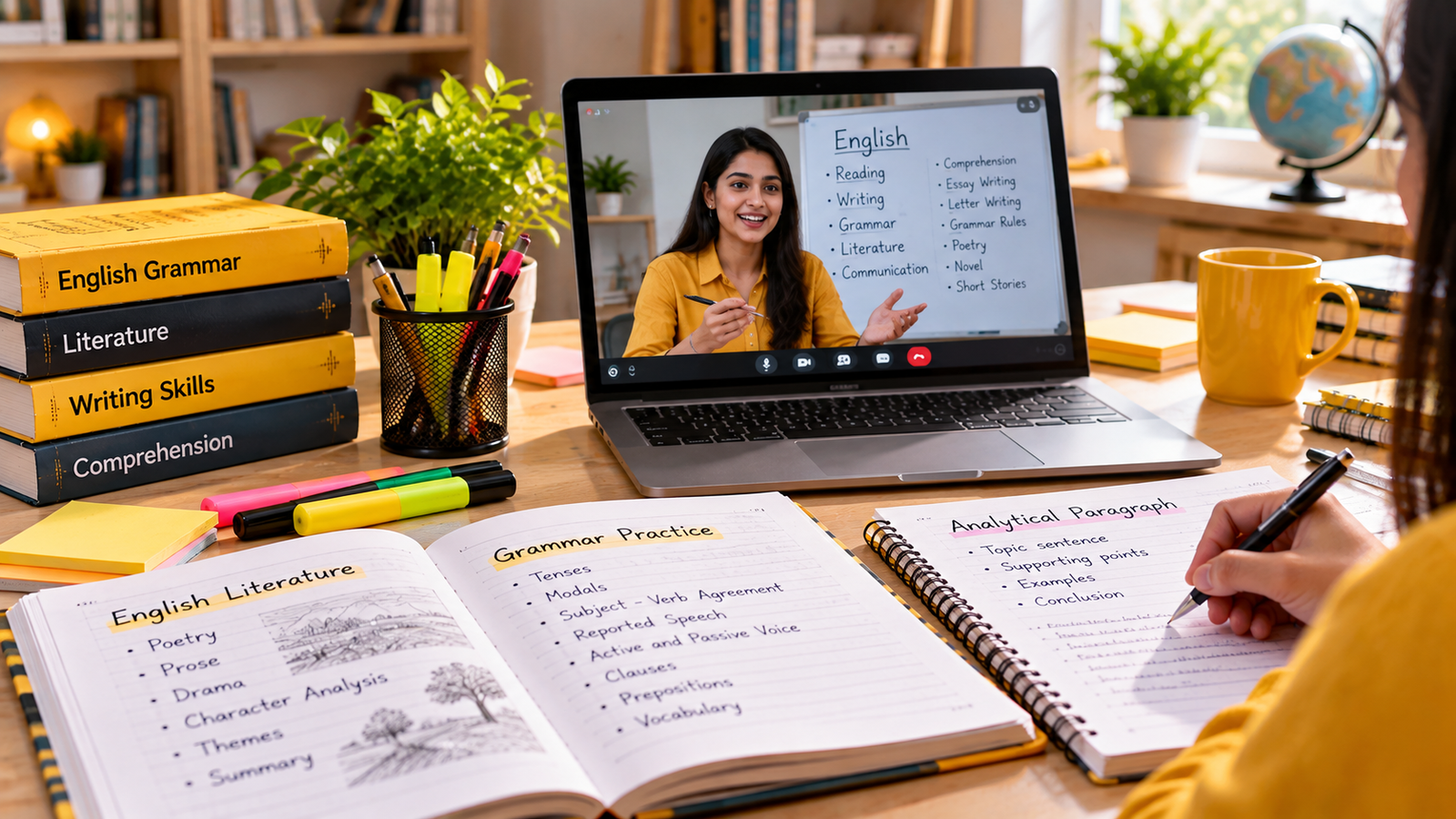
English learning often involves grammar, vocabulary, comprehension, literature and structured writing. Students can practise planning an answer, using evidence from a text, improving sentence clarity and checking spelling and punctuation. Speaking practice may also be discussed when it is part of the learner’s goals.
Social Science can require timelines, cause-and-effect explanations, geography concepts, map practice and answers that directly address the question. Students should learn to distinguish key facts from examples and use headings or points when the question calls for them.
For Commerce learners, Accountancy requires consistent numerical practice and careful working; Economics benefits from definitions, diagrams, data interpretation and application; Business Studies often requires explaining concepts and applying them to case-based questions. Ask about the exact class, board and chapters so tuition can be aligned with the student’s current course.
See the subject directory for additional learning areas.
Curriculum and Board-Specific Preparation

Students may follow CBSE, ICSE/ISC, a state board or an international curriculum such as Cambridge, IGCSE or IB. These programmes can differ in syllabus structure, assessment style, terminology and expectations for written responses. It is important not to assume that the same worksheet or revision plan suits every board.
When making an enquiry, share the board, class, subject and school’s current chapter list. If the student has an upcoming test, provide the test date and topics. The tutor can then discuss an appropriate plan based on the requirement and availability. For international curricula, specify the exact course or subject level rather than only saying “international board.”
Use official curriculum documents and the student’s school guidance as the source of truth for syllabus coverage. Tutors can support learning and practice, but families should verify exam dates, syllabus changes and formal assessment requirements through the relevant board or school.
How We Match a Tutor to Your Requirement

A useful enquiry starts with accurate details. Please share:
- Class and board: for example, Class 9 CBSE or Class 11 ISC.
- Subject(s): list each subject that needs support.
- Location: Panchkula sector or nearby locality.
- Learning goal: regular homework support, concept rebuilding, test preparation or revision.
- Preferred schedule: days and time windows that may work for the family.
- Format: home tuition or online live learning.
Based on the information and current availability, suitable options can be discussed. Please confirm the tutor’s subject fit, teaching experience, timing, fees, travel arrangements and any trial or demo terms before finalising. A good match is not only about qualifications; communication style and the student’s comfort with asking questions matter too.
Panchkula Sectors and Local Availability

Families can enquire about home tuition across Panchkula, including Sector 5, Sector 8, Sector 11, Sector 12, Sector 14, Sector 15 and Sector 20. These are enquiry areas, not a guarantee that a tutor is immediately available in every sector. Availability depends on the subject, class, preferred timings and tutor travel range.
If you live in a nearby area, mention the locality in your message rather than assuming coverage. This helps avoid wasted time and allows the requirement to be checked before arrangements are made. Please do not share sensitive personal information in a public comment; use the enquiry or WhatsApp channel for details needed to arrange tuition.
Home Tuition or Online Tuition: Which Is Better?

Home tuition may suit families who prefer a tutor to teach in the student’s home and where a suitable local tutor is available. It can make it easier to work through a notebook together and observe written practice directly.
Online tuition can offer more flexibility when travel is difficult or when the required subject specialist is not nearby. It works best when the student has a stable internet connection, a quiet study space and the willingness to participate actively. Online lessons should include questions, practice and feedback—not just passive screen time.
Neither format automatically guarantees better results. Consistent attendance, clear goals, suitable teaching, independent work and communication between student, tutor and parent are important in both. Explore online tuition options and compare them with your family’s needs.
A Simple Weekly Study and Revision Routine

A tutor can help establish a manageable routine, but students need time between lessons to practise independently. One possible structure is to review the day’s notes, attempt assigned questions, mark doubts and revisit earlier topics. The exact workload should be realistic for the child’s class and other commitments.
- After each lesson: write a brief summary and redo one example without looking at the solution.
- During the week: complete a small set of questions and note any recurring mistakes.
- Before a test: prioritise the prescribed topics, practise representative questions and review errors.
- After a test: analyse lost marks and convert them into specific practice goals.
Parents can support the routine by providing a quiet study space and asking what the student learned, what remains confusing and what the next practice task is. Avoid judging progress only by marks from a single test; look at accuracy, confidence, independent effort and whether old mistakes are becoming less frequent.
How Parents Can Track Progress

Before tuition starts, choose a few specific goals. Examples include solving a particular type of equation accurately, explaining a Science process, writing a structured long answer or completing homework more independently. A broad goal such as “become better at studies” is harder to measure than a clear skill.
Ask for periodic feedback on topics covered, areas that still need practice and the next learning target. Short topic quizzes, completed assignments and the student’s ability to explain a method can all provide useful signals. Marks may improve over time, but no tutor can honestly guarantee a particular score or rank because results also depend on attendance, practice, prior knowledge, school assessment and other factors.
If a student is not progressing, review the plan early: Are the goals realistic? Is the student completing practice? Are foundational gaps being addressed? Does the teaching style work for the learner? Open communication helps the family decide what to adjust.
Frequently Asked Questions About Home Tutors in Panchkula

How can I find a home tutor in Panchkula?

Contact The Infinity Home Tuitions at 8872180500 on WhatsApp or use the enquiry page. Share class, board, subjects, locality, preferred timings and learning goals so availability can be checked.
Which Panchkula sectors are covered?

Enquiries can be made for sectors including 5, 8, 11, 12, 14, 15 and 20. Actual tutor availability varies by subject, timing and location, so confirm your specific sector before making arrangements.
Can I request tuition for Maths and Science together?

Yes, mention both subjects and the student’s class and board. The team can discuss whether a suitable arrangement is available for the required subjects and schedule.
Do you provide tuition for Classes 11 and 12?

Families can enquire about senior-secondary subjects including Physics, Chemistry, Mathematics, Biology, Accountancy, Economics, Business Studies and English. Confirm the board, subject and current tutor availability.
Is online tuition available if a local tutor is unavailable?

Online tuition is another option to discuss. Visit online tuition to learn more and share the subject and class when enquiring.
How much does a home tutor in Panchkula cost?

Fees can vary with class level, number of subjects, frequency, lesson duration, tutor requirements and location. Share the full requirement and confirm the fee and payment terms before beginning; this page does not promise one fixed price for every student.
Can a tutor guarantee 90% marks or a top rank?

No responsible service should guarantee an exact result. Tutoring can provide explanation, practice and feedback, but outcomes depend on several factors including the student’s effort, attendance, starting level and assessment conditions.
What details should I send on WhatsApp?

Send the student’s class, board, subject(s), Panchkula sector, preferred days/times and the main learning goal. Avoid sending unnecessary sensitive information.
Make the First Month of Tuition Purposeful

During the first few weeks, focus on establishing a clear routine and understanding the student’s starting point. Review recent schoolwork, identify the topics that need attention first, and agree on a small number of achievable goals. A tutor can then use lessons for explanation and guided practice while the student completes independent work between sessions.
At the end of the month, review what has been covered, which questions the student can now solve independently, and what still needs revision. If the schedule is difficult to maintain or the workload is too heavy, discuss practical changes early. This regular review helps parents and tutors make decisions based on learning evidence rather than assumptions.
Parents should keep communication specific and constructive: share the topic causing difficulty, an upcoming school deadline or a schedule constraint. Clear information helps the tutor prioritise the next lesson and keeps expectations realistic for everyone involved.
Let’s Find the Right Tuition Plan for Your Child

Tell us the class, subject and Panchkula sector. We’ll discuss suitable home or online tuition options based on your requirements and current tutor availability.
WhatsApp Your Requirement
Call 88721 80500
Send Enquiry / Book Demo
Helpful next steps: Browse subjects · Compare online tuition · Explore live learning and free study material
Tutor matching, timings and fees are confirmed individually according to the requirement and availability.