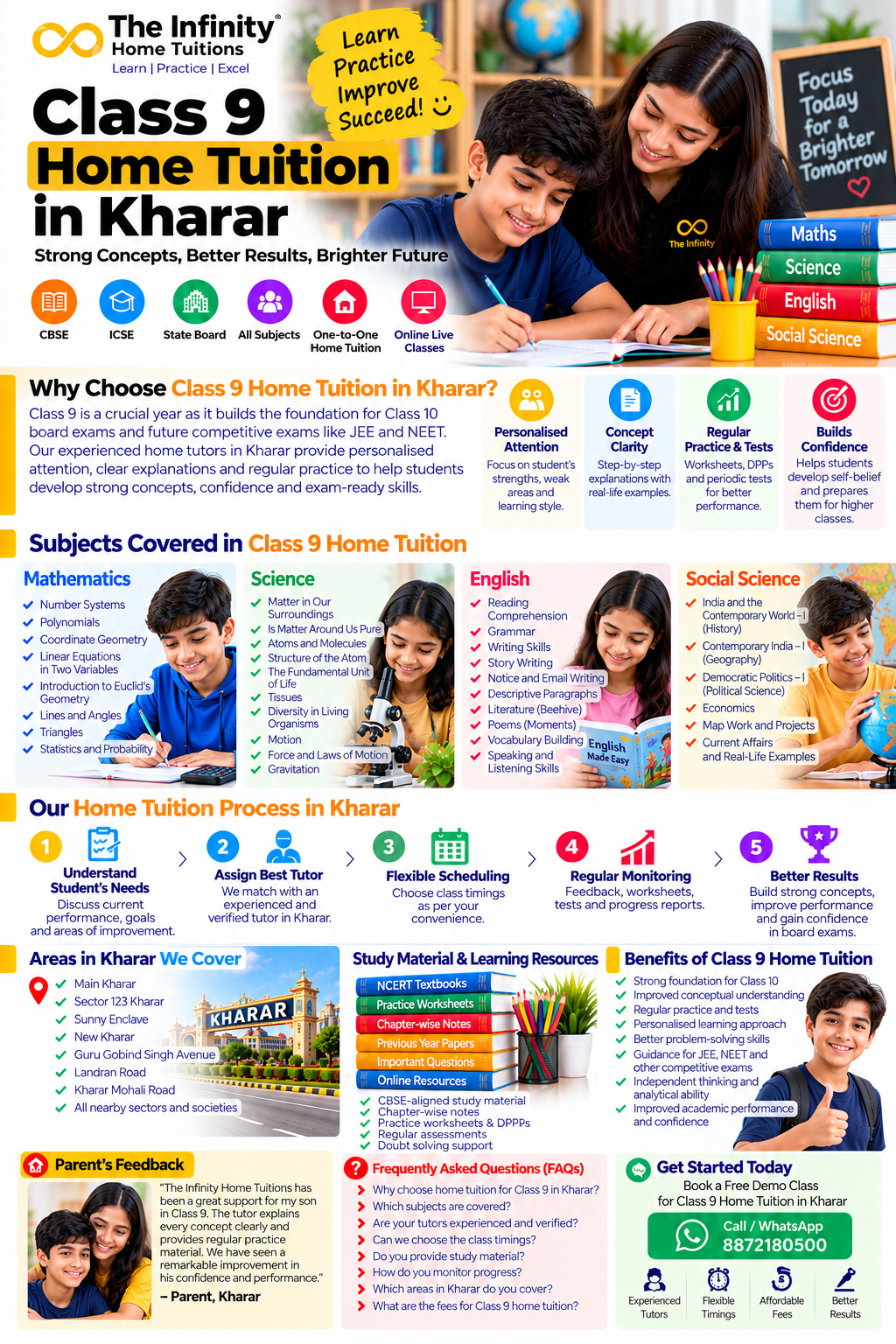
Class 9 Home Tuition in Kharar
Choose Class 9 home tuition in Kharar for focused support as students move into the secondary-school curriculum. The Infinity Home Tuitions provides personalised tutoring in Maths, Science, English and other subjects, with emphasis on conceptual understanding, written answers and regular revision.
Class 9 Academic Support
Maths and Science require students to understand concepts and apply them to unfamiliar questions. Tutors can work through examples, identify errors and provide chapter-wise practice.
- Mathematics concept building and problem solving
- Physics, Chemistry and Biology foundations within school Science
- English grammar, literature and writing
- Hindi and other school-subject support
- Homework, revision and school-test preparation
Build Strong Foundations for Class 10
A structured Class 9 routine can reduce learning gaps before board-oriented preparation begins in Class 10. Individual tuition allows extra time for difficult chapters without slowing down the entire syllabus.
Home Tuition in Kharar
Enquiries are accepted across Kharar and nearby areas such as Sunny Enclave, Sector 125, Sector 126, Landran Road and Khanpur, subject to tutor availability.
Online Tuition
If home tutoring is not convenient, online one-to-one tuition provides another option. See subjects we offer.
How to Start
- Share class, subjects and school/board.
- Tell us your Kharar location and schedule.
- Discuss current performance and learning goals.
- Confirm tutor availability and begin classes.
Book a demo or call 8872180500.
FAQs
Can tuition help with Maths and Science together?
Yes, a requirement can cover multiple subjects depending on tutor availability.
Can classes be online?
Yes, online one-to-one classes are available.
Ready to Learn with The Infinity Home Tuitions?
Choose a learning format that suits the student: personalised one-to-one online live classes or interactive group live classes. Enquire about the subject, class, board and learning goals to discuss suitable options.
Explore Classes & Free Study Material Download The Infinity App Call / WhatsApp: 8872180500
Explore: TheInfinity.live for live learning and FREE Study Material. Ask about one-to-one tuition, group live classes, tests, quizzes and exam practice where available.
Class 9 Mathematics Tuition: Build Conceptual Clarity
Class 9 Mathematics usually requires students to move beyond direct calculations and explain the steps behind a solution. Depending on the board and textbook, topics may include number systems, polynomials, coordinate geometry, linear equations in two variables, geometry, triangles, quadrilaterals, circles, mensuration, statistics and probability. The prescribed textbook should determine the exact chapter sequence. A tutor can identify the student’s current level, explain the underlying idea with worked examples and then provide questions that gradually increase in difficulty. Students should show their working, use correct notation and check whether their answers make sense.
Number Systems and Exponents
Number systems can involve rational and irrational numbers, decimal expansions, real numbers and laws of exponents, depending on the syllabus. Students should understand how numbers are represented and why a particular operation or rule applies. When an answer seems confusing, revisit definitions and examples instead of memorising a shortcut. A tutor can use number lines, decimal examples and step-by-step simplification to make the ideas clearer. Practise a few questions from each type, then mix the types so the learner has to decide which method is appropriate. Review sign errors and incorrect exponent rules carefully.
Polynomials and Algebraic Reasoning
Polynomials require students to recognise terms, coefficients, degrees, factors and identities as prescribed in their course. Encourage the learner to write each algebraic step clearly and explain why like terms can be combined or why an identity applies. Factoring and expansion become easier when students understand the relationship between the expressions rather than treat each exercise as a separate trick. Begin with a worked example, solve a similar question together and then let the student attempt one independently. If mistakes repeat, identify whether the issue is multiplication, signs, notation or concept understanding.
Coordinate Geometry and Linear Equations
Coordinate geometry connects algebra with points on a plane. Students should practise reading axes, identifying ordered pairs and plotting points carefully. Linear equations in two variables may be represented through tables, ordered pairs and graphs, depending on the curriculum. Explain what a solution represents before moving to plotting procedures. Students should label axes, choose a consistent scale and check that points match the equation. Repeated practice with small examples can build confidence. A tutor can also help students interpret a question and decide whether it asks for an algebraic result, a graph or an explanation.
Geometry, Triangles and Quadrilaterals
Geometry requires accurate diagrams, correct definitions and logical reasoning. Depending on the syllabus, students may work with lines and angles, triangles, congruence, quadrilaterals, circles or related properties. Teach the learner to identify what is given, what must be proved and which property connects the two. Diagrams should be neat and labelled, but students should not assume a relationship merely because it looks true in a sketch. Writing each reasoning step helps teachers assess understanding and helps students find where an argument needs improvement.
Mensuration, Statistics and Probability
Mensuration problems require students to select the appropriate formula, substitute values accurately and use the correct units. Make sure the learner understands what a measurement represents and distinguishes perimeter, area and volume where relevant. Statistics may involve collecting, organising and interpreting data, while probability introduces the likelihood of outcomes according to the course. Tables and simple visual examples can help students interpret information before calculating. Encourage them to check units, arithmetic and whether the final result is reasonable. Practice should include both direct formula questions and word problems.
Class 9 Science Tuition: Physics, Chemistry and Biology
Class 9 Science combines conceptual explanations, calculations, diagrams, definitions and practical reasoning. Depending on the curriculum, students may study matter, atoms and molecules, cell structure, tissues, motion, force, gravitation, work and energy, sound and natural resources. The tutor should follow the prescribed textbook and school lesson plan. Students benefit from connecting a definition to an example, describing a process in sequence and practising written answers using appropriate scientific terms. Science should not become only memorisation; learners need to understand relationships and apply ideas to new questions.
Physics: Motion, Force, Gravitation and Work
Physics topics may include motion, distance and displacement, speed and velocity, acceleration, graphs, force, Newton’s laws, gravitation, work, energy and sound, depending on the board. Students should learn to identify known quantities, select the relevant relationship, convert units and show each calculation step. Graphs and diagrams can make relationships easier to understand. A tutor can ask the learner to explain what a result means physically rather than stop after obtaining a number. Revisit definitions and units when formula selection becomes difficult, and practise questions from basic to application level.
Chemistry: Matter, Atoms and Molecules
Chemistry may include the nature and states of matter, mixtures, atoms, molecules, chemical formulae and laws or calculations specified by the syllabus. Students should distinguish observations from explanations and learn symbols and formulae accurately. When balancing or interpreting a chemical expression, encourage careful checking rather than guessing. Use textbook examples and explain why each step is required. A small revision sheet of definitions, symbols and common errors can help students prepare for tests. Safe classroom demonstrations or teacher-approved resources may support understanding; students should not attempt hazardous experiments at home.
Biology: Cells, Tissues and Living Organisms
Biology learning may cover cells, cell organelles, tissues, diversity, health or natural resources, depending on the course. Diagrams should be labelled accurately, and answers should explain the function of a structure rather than merely list its name. Comparison tables can help students distinguish similar terms. A tutor can guide the learner through a diagram, ask them to describe the function in their own words and then help refine the answer using textbook terminology. Short, spaced revision sessions are useful for retaining scientific vocabulary and processes.
English: Reading, Grammar and Literature
Class 9 English often combines comprehension, grammar, literature and different writing formats. Students should practise reading a passage carefully, identifying its main idea and supporting details, and answering in a direct, well-structured way. Literature answers may need evidence from the prescribed text and explanation of a character, theme or event. Grammar practice is most effective when learners apply rules in sentences rather than memorise definitions alone. The tutor should use the student’s current textbook and school assessment format to decide which skills need priority.
Writing Skills: Paragraphs, Notices, Letters and Articles
Written tasks require students to understand the format, purpose, audience and word limit set by the school. Teach a short planning process: identify the task, list relevant points, arrange them logically, draft the response and proofread. Students should check punctuation, grammar, spelling and whether they have answered every part of the prompt. A tutor can review one draft and explain the most important corrections, then ask the learner to revise it. Copying a model response is less useful than learning how to organise ideas independently.
Social Science: History, Geography and Civics
Social Science may include history, geography, political science and economics according to the board and prescribed textbook. Students should understand key concepts, chronology, locations and cause-and-effect relationships rather than memorise isolated sentences. Timelines can help with historical sequence, maps with spatial understanding, and comparison tables with similarities and differences. For long answers, identify the command word, select relevant points and organise them into a clear structure. The tutor should ensure that notes and practice questions match the current course rather than introduce unrelated material.
Map Work, Diagrams and Long Answers
Map work requires careful reading of the question, correct location identification and neat labelling according to school instructions. Diagrams and flowcharts can help students present processes or relationships clearly. Long answers should be organised into a brief opening statement, relevant supporting points and a concise conclusion where appropriate. Practise using the key terms expected by the textbook, but avoid adding information that does not answer the question. A tutor can help the student use a marking scheme or teacher feedback to identify where detail, accuracy or organisation needs improvement.
Homework Planning and Independent Learning
Students should attempt homework themselves after the concept has been explained. If they become stuck, they can mark the question, write what they have tried and bring it to the tutor. This makes support more precise and encourages independent thinking. Use a planner to record assignments, test dates and revision targets. Break a large task into smaller steps and start early enough to ask questions. The tutor can demonstrate the first example, guide a second and then check the student’s independent attempt. The goal is to develop skills the learner can use without constant assistance.
Exam Preparation and a Revision Calendar
Effective revision begins with a clear view of the syllabus and assessment dates. List chapters, mark topics that need attention and divide them across realistic study sessions. Use active recall by closing the book and explaining a concept, then check notes to correct gaps. Practise textbook questions and school-style papers once the material is understood. After each practice test, classify errors and revise the underlying skill. Avoid relying entirely on last-minute study or excessively long sessions. Rest, sleep and balanced breaks support concentration and make a realistic revision plan easier to maintain.
How to Analyse Test Mistakes
A low score does not always mean the student has not studied enough. Mistakes can arise from a concept gap, forgotten information, a calculation slip, misunderstanding the instruction, incomplete working or poor time management. Review each incorrect answer and identify its cause before repeating the question. Re-teach concepts that are unclear, practise calculations where accuracy is weak and use timed sets when pacing is the problem. Keep a short error log with the question type, the reason for the mistake and the corrected method. Revisit this log during revision to check whether the error has reduced.
One-to-One Tuition and Group Live Classes
One-to-one tuition can provide focused attention and a pace tailored to the student’s learning needs. Group live classes may offer peer interaction and a shared lesson structure, depending on the available course. The best option depends on the learner’s confidence, schedule, subject and need for individual feedback. Ask what format is available, how questions are handled and what practice or revision is included. For online sessions, prepare the textbook, notebook and a quiet workspace, and ensure the internet connection is reliable. Confirm actual availability before choosing a timetable.
Local Kharar Tutor Matching and Areas
Families can enquire from Kharar and nearby localities such as Sunny Enclave, Sector 123, Sector 125, Landran Road and Khanpur. Tutor availability depends on the precise location, subject, board, timetable and suitable tutor match; area mentions are not a guarantee of immediate placement. When enquiring, share the student’s class, school board, subjects, preferred timing and topics that need support. Discuss whether in-person lessons or online one-to-one classes are more convenient. Confirm the tutor, schedule, fees and expectations before lessons begin.
How to Choose the Right Class 9 Tutor
Ask how the tutor explains difficult concepts, checks understanding and helps students correct errors. Share recent schoolwork or test questions to illustrate the areas needing attention. Confirm experience with the relevant board and subjects, lesson duration, frequency, fees, cancellation terms and how progress will be communicated. A good tutor encourages questions, provides clear feedback and gradually builds independent problem-solving. Be cautious of guaranteed marks or ranks; no provider can responsibly promise a specific result. Agree on practical goals such as stronger algebra skills, clearer written answers or a more consistent revision routine.
Study Materials, Notes and The Infinity App
The prescribed textbook and teacher instructions should remain the primary references for Class 9. Supplementary notes, chapter-wise practice, quizzes and sample questions can help when they match the syllabus and the student’s learning needs. The Infinity platform promotes resources such as courses, books, tests, quizzes, notes and lectures; availability can vary by course. Visit [TheInfinity.live](https://theinfinity.live/) for live learning and free study material, or [download The Infinity App](https://play.google.com/store/apps/details?id=com.dqawyh.ztmscp). Use additional resources to reinforce understanding rather than replace the school’s current requirements.
Frequently Asked Questions About Class 9 Tuition in Kharar
Can I enquire about Class 9 tuition in Kharar? Yes, enquiries are welcome and arrangements depend on tutor availability. Which subjects can be covered? Families can ask about Maths, Science, English, Social Science and other school subjects. Can tuition follow CBSE or another board? Share the exact board and textbook so the plan can be aligned. Are online classes possible? Online one-to-one live learning can be discussed. Can a tutor guarantee marks? No responsible provider can guarantee a particular score; outcomes depend on prior learning, attendance, practice and school assessments. What should I share when enquiring? Provide the locality, subjects, schedule and topics needing support.
How to Enquire About Class 9 Home Tuition
Share the student’s board, subjects, Kharar locality, preferred schedule and learning goals. Mention upcoming exams and any topics that need extra practice. Use the [Book Demo page](https://theinfinityhometuitions.com/book-demo/) or contact The Infinity Home Tuitions through [WhatsApp at 8872180500](https://wa.me/918872180500). Tutor availability and final arrangements are confirmed after discussion. Explore [Subjects We Offer](https://theinfinityhometuitions.com/subjects-we-offer/) and [Online Tuition](https://theinfinityhometuitions.com/online-tuition/) for related options.
Official Curriculum and Learning Links
Confirm the current board, textbook and syllabus with the school before using supplementary notes or sample papers. For CBSE academic information, visit the [official CBSE Academic website](https://www.cbseacademic.nic.in/). Families can also explore [Subjects We Offer](https://theinfinityhometuitions.com/subjects-we-offer/) and [Book Demo](https://theinfinityhometuitions.com/book-demo/). The most useful practice resource is one that matches the student’s current course. Ask the tutor how additional questions connect with topics taught at school.
Tracking Progress with Realistic Goals
Review progress through independent work, homework quality, practice accuracy and the student’s ability to explain concepts. Marks are one signal but do not show every change in understanding. If the same mistake continues, share a specific example with the tutor and agree on a next step. Set measurable goals, such as solving a particular question type accurately or improving the structure of a written answer. Review the plan periodically and adjust it to school deadlines. Consistent practice and attendance help, but no particular score can be promised.