Class 2 Home Tuition in Kharar | The Infinity Home Tuitions
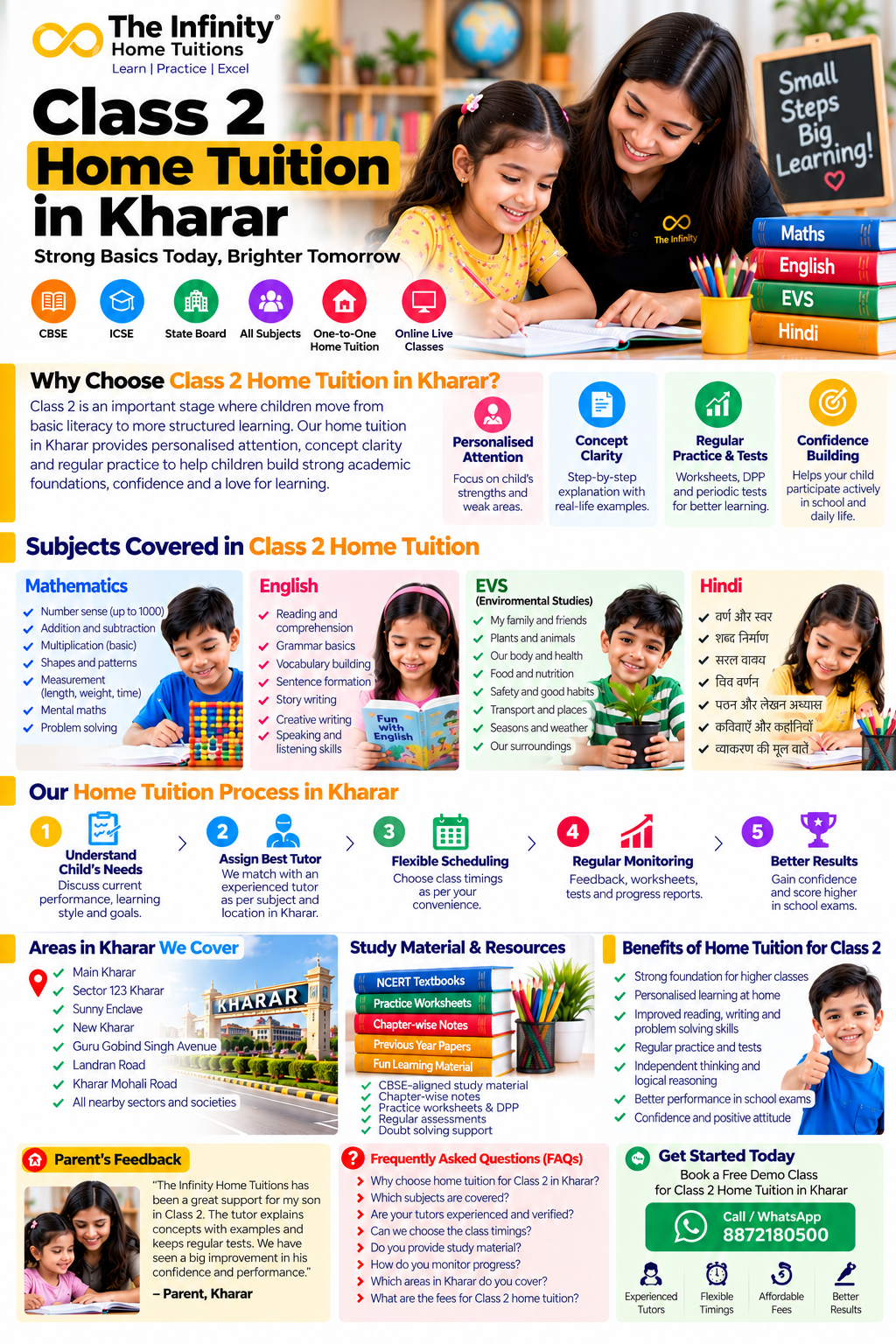
Looking for Class 2 home tuition in Kharar? The Infinity Home Tuitions welcomes enquiries from families seeking structured academic support in Mathematics, English, Hindi, EVS and other school subjects, subject to tutor availability. Lessons can follow the child’s school syllabus and learning pace, with short practice activities, clear explanations and encouragement. The aim is to strengthen reading, writing, number skills and confidence while helping the child develop a positive routine for school learning.
What Does Class 2 Home Tuition in Kharar Include?
Class 2 tuition can support classroom learning through concept explanations, reading and writing practice, mathematics activities, homework guidance and revision. The exact plan should follow the child’s school textbook and board because topic order and expectations can vary. A tutor can first identify what the student already understands, then focus on a few priority skills. Lessons should include guided examples and independent attempts, giving the child time to ask questions and explain answers. This helps identify learning gaps without repeating material the student has already mastered.
Why Class 2 Is an Important Foundation Year
Class 2 is a stage when children strengthen basic literacy and numeracy and begin to use these skills in more varied tasks. Reading fluency, spelling, sentence formation, place value, addition, subtraction and early multiplication can support later school learning. If a child is uncertain about a foundational skill, newer topics may feel difficult. A consistent, supportive routine gives the learner time to practise, ask for clarification and correct mistakes. Tuition should complement school instruction, not create unnecessary pressure or rush through the syllabus before core skills are secure.
Class 2 Mathematics Home Tutor in Kharar
Depending on the school curriculum, Class 2 mathematics may include number recognition, place value, ordering numbers, addition, subtraction, early multiplication, patterns, shapes, measurement, time, money and word problems. Confirm the exact topics using the child’s textbook. A tutor can use counters, drawings, number lines and everyday examples before moving to written calculations. Children should learn to explain how they reached an answer, check calculations and estimate whether a result makes sense. Short, regular practice can build fluency, but understanding the method matters more than finishing a large worksheet quickly.
Number Sense and Place Value
Number sense develops when children connect number names, written numerals and quantities. Group objects into tens and ones, compare numbers and practise putting numbers in order. Place-value charts and bundles of sticks can help explain why a digit’s position changes its value. A tutor can ask the child to represent a number in more than one way, then connect the model to written notation. If the learner confuses tens and ones, revisit the concrete example before introducing more complex calculations. This foundation supports addition, subtraction and later arithmetic.
Addition, Subtraction and Early Multiplication
Addition and subtraction practice should include both calculation and understanding what each operation represents. Objects or drawings can show combining groups, taking away, comparing amounts and finding a missing number. If multiplication appears in the prescribed syllabus, equal groups, arrays and repeated addition can introduce the idea visually. Once the child understands the concept, use textbook-style examples and gradually increase variety. When errors recur, ask the learner to explain the steps rather than simply providing the correct answer. This makes it easier to locate the exact misunderstanding and practise it.
Word Problems and Everyday Mathematics
Word problems teach children to apply mathematics in a situation rather than choose an operation based only on a keyword. Encourage the child to read the full question, identify what is known, decide what needs to be found, choose a method and check the result in context. Everyday examples involving toys, classroom objects, shopping or sharing can make the meaning clear. A tutor can model one example and then let the learner solve a similar problem independently. If the student struggles with reading the question, support comprehension as well as calculation.
English Reading and Comprehension
Reading practice can help children recognise words more fluently, understand vocabulary, follow a sequence and answer questions about a passage. Encourage the student to read carefully and return to the text to find relevant details. For a story, the child can describe the characters, setting and order of events. Short, regular reading sessions are often easier to maintain than occasional long sessions. A tutor can select texts at an appropriate level and gradually introduce more challenging material as vocabulary and comprehension improve. Families should follow the school’s reading approach and textbook.
English Grammar, Spelling and Writing
Class 2 English may include sentence construction, punctuation, spelling, vocabulary, grammar, short paragraphs, stories and other formats prescribed by the school. A tutor can explain a rule, model an example and ask the child to create a sentence independently. Feedback should be specific and encouraging: identify one area to improve, explain why and allow another attempt. Writing practice should develop clear meaning and logical order, not just copying. Reading aloud and talking about familiar experiences can help children generate ideas before putting them into sentences.
Hindi Reading, Grammar and Writing
Hindi lessons may cover वर्ण recognition, मात्रा, शब्द निर्माण, simple sentences, reading comprehension, vocabulary and writing, depending on the school syllabus. A tutor can use familiar words, picture prompts and oral practice to connect sounds, letters and meanings. Written work should be gradual, with attention to letter formation and मात्रा placement where relevant. The prescribed textbook and teacher instructions should guide the sequence. Families should share the current chapters so tutoring remains consistent with school learning and does not introduce unfamiliar methods without explanation.
EVS and Learning About the World
Environmental Studies may include family, school, plants, animals, food, health, transport, weather, water and the local environment, depending on the curriculum. Pictures, safe observations and everyday discussion can make these concepts memorable. A tutor might ask the child to describe a plant, identify healthy habits or explain how to keep surroundings clean. Encourage complete sentences and careful observation rather than memorising definitions alone. Activities should be age-appropriate and safe. The child’s textbook should determine which topics are practised for school assessments.
Homework and School Assignment Support
Homework provides an opportunity to practise independently after a lesson. If the child becomes stuck, help them understand the instruction and identify the first step rather than completing the answer on their behalf. Mark difficult questions to discuss with the tutor. A simple checklist can help the child remember assignments and bring the right books home. Tutoring homework should remain manageable and connected to school learning. The aim is to improve understanding and responsibility, not overload the child with repetitive tasks after a full school day.
Building Confidence and a Positive Study Routine
Children learn at different speeds, and confidence affects whether they attempt challenging work. A supportive tutor makes it normal to ask questions, explain an attempt and correct a mistake. Set small goals, such as reading a short passage, practising a number pattern or writing a clear paragraph. Notice effort and improvement, not only correct answers. Avoid comparing the child with classmates. A calm routine, regular practice and specific encouragement can help students become more willing to try difficult tasks and gradually work more independently.
How One-to-One Tuition Supports Class 2 Students
One-to-one lessons allow a tutor to adjust the pace, repeat instructions and choose examples suited to the child’s needs. A learner who confuses a number concept can practise with objects; a child who reads accurately but struggles with meaning can work on comprehension. Lessons should include explanation, guided practice and independent attempts. Short focused activities may work better than a long uninterrupted session for young learners. The aim is to build understanding and gradually reduce the help required, rather than make the child dependent on a tutor for every answer.
Home Tuition Areas in Kharar
Families can enquire from Kharar and nearby localities such as Sunny Enclave, Sector 125, Sector 126, Landran Road and Khanpur. Availability depends on the exact location, subject, day, time and suitable tutor match, so mentioning an area does not guarantee immediate placement. Share the child’s class, board, subjects, locality and preferred timings when contacting the team. If in-person lessons do not fit the family schedule, ask whether online one-to-one live classes may be suitable. Confirm the tutor and timetable before making arrangements.
How to Choose a Suitable Class 2 Tutor
Ask how the tutor explains concepts, checks understanding and adapts when the child finds a topic difficult. A suitable tutor should encourage questions and independent attempts rather than only dictate notes. Share schoolwork or topics needing attention so early lessons focus on real learning needs. Parents should confirm lesson duration, schedule, fees, communication arrangements and cancellation expectations before starting. Tutor matching depends on the child’s needs and actual availability, so clear communication helps families assess whether the arrangement is suitable. Avoid promises of guaranteed marks; focus on learning goals and progress.
A Simple Weekly Study Routine
A balanced routine may include reviewing class notes, completing homework, practising mathematics, reading for a short period and revising an older topic. Divide larger tasks into smaller steps with one clear goal at a time. For example, the child can practise a few sums, read a page and explain the main idea, then check schoolwork. Leave time for play, rest and sleep. Adjust the routine around school deadlines and family commitments. A realistic plan followed consistently is more useful than a demanding schedule that causes frustration.
Worksheets, Revision and Practice Tests
Worksheets can reinforce a concept after it has been explained, but they should not replace clear teaching. Begin with questions that check understanding, then include a few that require applying an idea in a different context. Short quizzes can identify topics for review without making every activity feel like an examination. After a mistake, ask what the child tried and guide them to find the missing step. Practice should target the specific skill that needs attention rather than simply increase homework volume. Follow the school’s assessment expectations.
Home Tuition or Online Live Classes?
Home tuition may suit families who prefer an in-person tutor, subject to local availability. Online one-to-one live classes can be convenient when travel is difficult or the family prefers a digital option. Online lessons work best with reliable internet, a quiet space and the child’s books ready; younger learners may also need an adult nearby. Families can ask about group live classes if suitable. Choose the format based on the child’s attention, schedule, subject and comfort. See the [Online Tuition page](https://theinfinityhometuitions.com/online-tuition/) for more information.
Study Resources and The Infinity App
The school textbook and teacher instructions should remain the main reference for Class 2. Supplementary worksheets, notes and quizzes can support revision when they match the curriculum. The Infinity learning platform promotes resources such as courses, books, tests, quizzes, notes and lectures; available features may vary by course. Visit [TheInfinity.live](https://theinfinity.live/) for live learning and free study material, or [download The Infinity App](https://play.google.com/store/apps/details?id=com.dqawyh.ztmscp). Choose age-appropriate resources that reinforce school learning rather than replace prescribed material.
How Parents Can Support Learning at Home
Parents can provide a calm study space, help the child record homework and ask what they learned that day. If the child is stuck, ask what they have tried before offering a hint. This encourages problem solving and helps identify the point of confusion. Notice effort, curiosity and improved habits as well as test results. Keep the routine balanced with play and rest. Share concerns with the tutor early so the learning plan can be adjusted before a small gap becomes frustrating.
Frequently Asked Questions About Class 2 Tuition in Kharar
Do you accept Class 2 tuition enquiries in Kharar? Yes, enquiries are welcome and arrangements depend on suitable tutor availability. Which subjects can be covered? Families can ask about Maths, English, Hindi, EVS and other school subjects. Can tuition follow the school textbook? Lessons can be planned around the textbook and current topics shared by the family. Is online tuition available? Online one-to-one live learning can be discussed. Can a tutor guarantee marks? No specific score can responsibly be guaranteed; progress depends on practice, attendance, prior learning and school assessment.
How to Enquire About Class 2 Home Tuition
Share the child’s class, board, subjects, Kharar locality, preferred schedule and current learning goals. Mention whether you prefer home tuition or online learning and include any topics that need extra practice. Use the [Book Demo page](https://theinfinityhometuitions.com/book-demo/) or contact The Infinity Home Tuitions through [WhatsApp at 8872180500](https://wa.me/918872180500). Tutor availability and final arrangements are confirmed after discussion. Browse [Subjects We Offer](https://theinfinityhometuitions.com/subjects-we-offer/) and [Online Tuition](https://theinfinityhometuitions.com/online-tuition/) for related options.
Official Curriculum and Learning Resources
Confirm the current curriculum and prescribed textbook with the school before using supplementary worksheets or sample material. For CBSE academic information, visit the [official CBSE Academic website](https://www.cbseacademic.nic.in/). Families can also explore [Subjects We Offer](https://theinfinityhometuitions.com/subjects-we-offer/) and [Book Demo](https://theinfinityhometuitions.com/book-demo/). The most useful resource is one that matches the child’s class, language and current schoolwork. Ask the tutor how additional activities support the topics being taught in class.
Preparing for the First Tuition Session
Before the first session, keep the child’s school books, notebook, diary and recent assignments ready. Share the topics the child enjoys and the skills that feel difficult, such as reading a sentence or solving a sum. This helps the tutor begin at an appropriate level. After the session, ask the child to show one thing they practised and tell you how it went. Keep the discussion encouraging and brief. A good start is based on understanding the child rather than rushing through many pages.
Tracking Progress Without Pressure
Review progress by noticing what the child can do independently, such as reading more fluently, writing more clearly, calculating accurately or explaining an idea. Marks are only one signal and may not show every improvement. If a difficulty continues, share a specific example with the tutor and agree on a small practice goal. Keep expectations realistic and avoid comparing the child with classmates. Consistent practice, attendance, school instruction and the child’s starting point all affect progress. The aim is steady skill development and a positive relationship with learning.
Creating a Child-Friendly Learning Space
Choose a quiet, comfortable place with good lighting and the books needed for the lesson. Keep pencils, counters, picture cards or drawing paper nearby if they support the activity, but avoid filling the table with distractions. Short sessions with a clear purpose are easier for young learners to follow. A simple plan might include reading, a short writing task and a few number questions, with movement breaks as needed. Adjust the pace to the child’s attention and energy rather than expecting every lesson to look the same.
Working Together with the School
Tutoring works best when it complements what the child is learning in school. Share current chapters, homework instructions and teacher feedback where available, and let the tutor know if the school changes the pace or assessment schedule. Prioritise the skills that matter most for the child’s current stage instead of teaching many unrelated topics at once. Calm communication between parent and tutor can help identify progress and decide what to practise next. The goal is to support the child, not create competing routines or unnecessary workload.
Enquire About Class 2 Home Tuition in Kharar
Share the child’s subjects, board, locality and preferred schedule to discuss suitable learning options.
Book a Demo Download The Infinity App WhatsApp 8872180500
Explore TheInfinity.live for live learning and free study material.