For CBSE Class 10 Mathematics, case-based and competency-focused questions ask students to apply concepts to realistic situations, interpret data, and explain the reasoning behind a result. They can combine algebra, geometry, trigonometry, statistics, probability and mensuration in a single context. This guide offers a practical approach to solving these questions for the 2026–27 academic session. Use it as a method guide: the exact format and chapter coverage should always be checked against the current official syllabus and your school’s instructions.
Check the current official syllabus and assessment instructions with your school. Use the CBSE Academic website for curriculum information and the NCERT textbook portal for prescribed learning material. This is a study guide, not an official paper or a guarantee of questions appearing in the examination.
For a broader preparation timetable, explore online tuition options and the learning resources on The Infinity Home Tuitions website. Work through the sections one at a time, then practise mixed questions without looking at the notes.
1. What Competency-Based Mathematics Questions Test
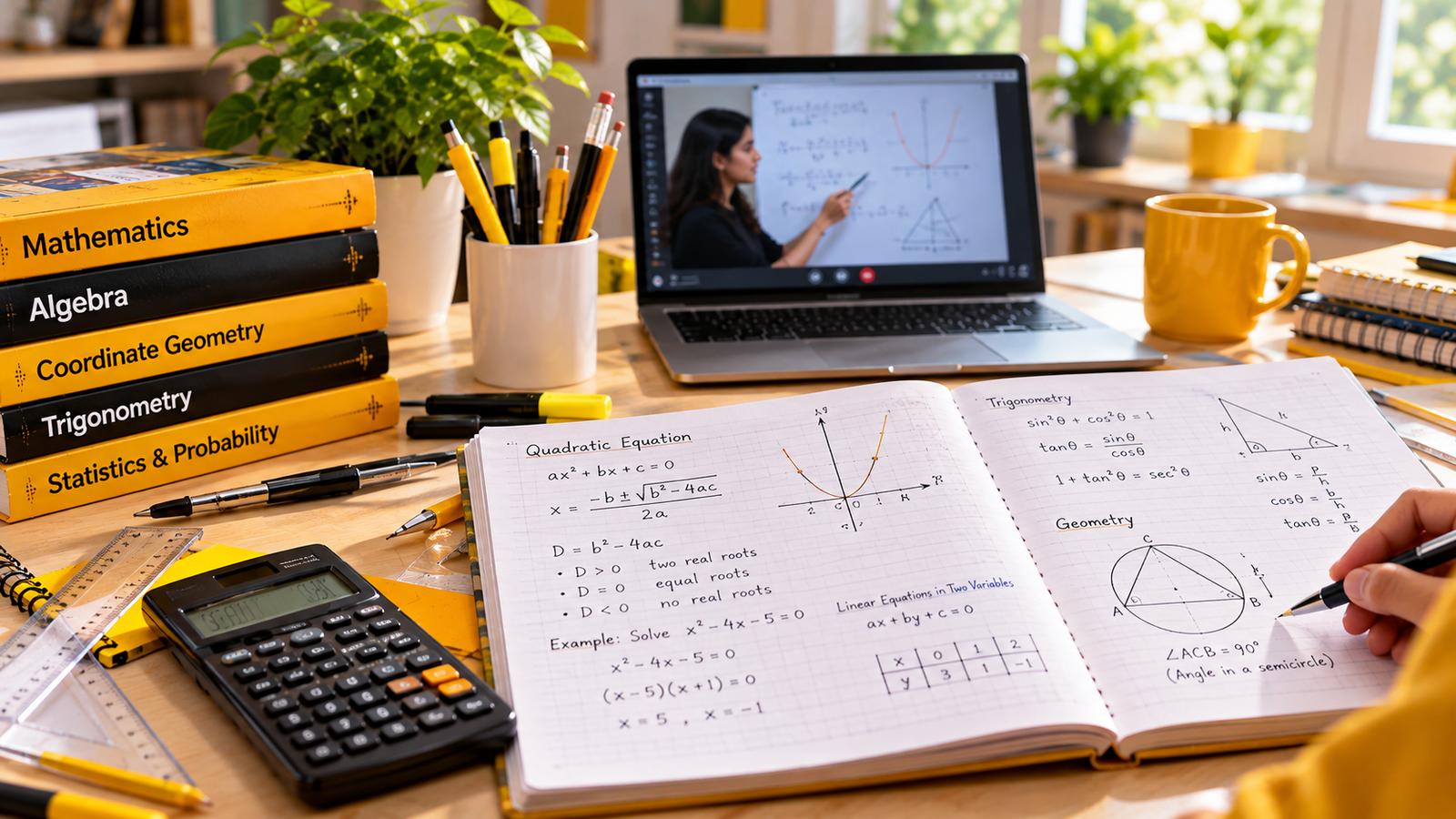
Competency-based questions ask students to apply mathematical ideas to a situation, interpret information, choose a method and justify a result. They may use a short passage, table, diagram, graph, plan or real-life scenario. The goal is not to guess the examiner’s intention but to translate the information into mathematics. Read the entire case before attempting subparts. Underline quantities, units, conditions and the exact requirement in each question. A context can include details that are not needed for every subpart, so separate relevant data from background information. Practise explaining why a formula or theorem applies, not only writing the final number. A useful habit is to summarise the situation in one sentence before beginning the calculations.
2. Read the Case Study Before Calculating
Begin with a quick first read to understand the setting, such as a garden layout, school event, savings plan or survey. On the second read, mark all numerical values and note what each represents. Check whether lengths are in metres or centimetres, whether money is monthly or annual, and whether a percentage is based on the original or changed amount. Then read each sub-question separately. Some parts may be independent, while others use a result from an earlier part. If a later answer depends on an earlier result, carry forward the correct value and keep intermediate calculations unrounded unless the question requests rounding. This two-pass reading routine can prevent avoidable errors.
3. Linear Equations in Everyday Contexts
Linear equations can model fixed charges, ticket prices, age relationships, distances at constant speed or purchases with two unknown quantities. Define variables clearly before writing an equation. For example, if a service charges a fixed fee plus a cost per hour, total cost can be expressed as C = a + bh, where a is the fixed charge and b is the hourly rate. Translate each sentence into a relationship and solve systematically. When two unknowns are involved, look for two independent equations and use substitution or elimination. Finally, substitute the solution into the original conditions to confirm that it satisfies both relationships and makes sense in the scenario. Always define symbols so the final answer is easy to interpret.
4. Quadratic Equations and Area Problems
Quadratic equations often appear when a rectangular area, path width or product of two changing quantities is described. Draw a labelled sketch if dimensions are involved. Express the unknown dimensions in terms of a variable, form the equation and simplify it into standard form. Solve using factorisation, completing the square or the quadratic formula as appropriate. Algebra may produce two roots, but the context determines which are valid. A negative length or an impossible dimension must be rejected even if it is mathematically a root. Check the accepted solution by calculating the original area or condition, and write the final answer with units. Do not discard a root without checking the context.
5. Arithmetic Progressions in Seating and Savings

Arithmetic progressions model sequences in which consecutive terms differ by a constant amount. Real-life settings can include rows of seats, repeated savings increases or patterns of tiles. Identify the first term, common difference, number of terms and whether the question asks for a particular term or the sum of terms. The nth-term formula and sum formula answer different questions; do not substitute one for the other. Translate “the tenth row” into a term question, while “the total number of seats in all rows” is a sum question. If the pattern is described verbally, write the first few terms before selecting the formula. Confirm the common difference remains constant.
6. Coordinate Geometry and Map-Based Questions
Coordinate geometry can represent locations on a grid, a route between points or the position of a landmark relative to an origin. Plot or label the coordinates before calculating. The distance formula measures straight-line distance between two points, while the midpoint formula gives the centre of a segment. A coordinate diagram helps identify signs and distinguish horizontal from vertical change. For area questions, arrange the points in a consistent order and check that the shape described matches the coordinates. Do not assume that a drawn diagram is to scale; use the coordinates and given information for calculations. Include units if the coordinates represent physical distances. A sketch is a check, not a replacement for calculation.
7. Similar Triangles and Indirect Measurement

Similar-triangle contexts may involve a tree and its shadow, a building viewed from a point, or dimensions on a scale drawing. Identify the corresponding angles and sides before writing a proportion. Equal corresponding angles establish similarity under the relevant criterion, and corresponding side ratios must be used in the same order. A common error is to compare a side from one triangle with a non-corresponding side from the other. Label both triangles and mark corresponding vertices. After solving the proportion, verify that the larger triangle’s scale is consistent with the stated measurements and explain what the calculated length represents in the scenario. Keep the units consistent throughout.
8. Trigonometry and Heights-and-Distances Scenarios

In a right-triangle situation, first identify the angle of elevation or depression and label the opposite, adjacent and hypotenuse sides relative to that angle. Select sine, cosine or tangent based on the sides known and required. Draw a right triangle and include the vertical height and horizontal ground distance separately. Check whether the observer’s eye height needs to be added to the calculated height. Use the angle mode and calculator settings required by your class, and round only at the requested stage. The final answer should state whether it represents a height, horizontal distance or line-of-sight distance. A labelled diagram often makes the correct ratio obvious.
9. Circles, Tangents and Geometric Reasoning
Case-based geometry questions may describe a circular park, a road touching a circular boundary or a design involving tangents. Recall that the radius drawn to the point of tangency is perpendicular to the tangent. Tangents drawn from the same external point to a circle have equal lengths. These facts often allow a diagram to be split into right triangles. Mark the centre, radius, tangent point and external point clearly before applying Pythagoras’ theorem or another relationship. Explain the geometric fact that justifies each equation. Do not infer a tangent or right angle from appearance alone unless the question states or establishes it. Write the theorem in words when a reason is requested.
10. Areas Related to Circles and Composite Figures
A landscaped area, circular fountain or track may combine a circle with a rectangle, triangle or sector. Break the figure into familiar shapes and write the relevant area or circumference formula beside each part. Decide whether the question asks for the whole area, the shaded area, the boundary length or the cost of paving. For shaded regions, subtract the excluded area from the total area; for a boundary, add only the lengths that actually form the boundary. Use a consistent value of π and keep units squared for area and linear units for length. A quick labelled sketch helps prevent counting the same region twice. Check whether the question asks for a curved length or a full circumference.
11. Surface Areas and Volumes in Packaging
Packaging cases often compare cylinders, cones, spheres, hemispheres or combinations of solids. Identify the solid and whether the question asks for curved surface area, total surface area or volume. For a combined solid, calculate each component separately and combine only the surfaces that are exposed. For example, a joined surface may not contribute to the outside area of the final object. Volume measures capacity, while surface area measures material covering the object; these are not interchangeable. Convert all dimensions to the same unit before calculating. State cubic units for volume and square units for area, and check whether the answer is a plausible size for the object described. Draw a simple model when several solids are joined.
12. Statistics: Read Tables and Choose the Correct Measure

A case study may provide grouped data, a frequency table or information about marks, travel times or daily usage. Read the column headings and total frequency carefully before calculating. Mean, median and mode describe different aspects of a distribution, so choose the measure requested. For grouped data, use class marks and frequencies according to the method taught in the prescribed course. The median requires attention to cumulative frequency and the relevant class, while the mode identifies the most frequent value or modal class. If a question asks for interpretation, describe what the result says about the dataset rather than merely repeating the numerical answer. Check that the frequencies add to the stated total.
13. Probability in Games and Surveys
Probability questions may describe cards, dice, coloured objects or responses to a survey. Define the sample space and identify the favourable outcomes before applying probability as favourable outcomes divided by equally likely total outcomes. Do not assume outcomes are equally likely unless the situation supports that assumption. For selection without replacement, the total number of available objects changes after the first selection. In survey questions, distinguish the proportion of respondents from the probability of a random selection only when the sampling context supports that interpretation. Give probability values between zero and one and simplify fractions where possible. Explain the event being calculated so the answer is unambiguous. If outcomes are not equally likely, use the information given rather than a simple count.
14. Financial Contexts: Discounts, Budgets and Percentages

Budget and shopping contexts test percentage calculations, discounts, taxes, savings and comparisons. Identify the base amount for every percentage. A 10% discount is calculated from the marked price, while a later percentage increase may apply to the discounted amount rather than the original price. Keep money values in the same currency and distinguish percentage points from percent change when comparing rates. If several items are bought, calculate each item’s cost and then total them; apply a discount to the correct eligible amount. Check whether the question gives a fixed charge, tax or delivery cost that must be added separately. State the final monetary amount clearly. Explain each stage if multiple discounts or changes are involved.
15. Tables, Graphs and Data Interpretation

Tables and graphs provide information compactly, but students must check axes, scales, units, legends and time periods before calculating. A graph may not start at zero, and unequal tick intervals can change visual interpretation. Read the exact data points rather than estimating from a rough visual when precise values are supplied. For a trend question, describe the direction and compare relevant values. For a rate-of-change question, identify the difference in the dependent quantity divided by the difference in the independent quantity. If the graph shows a relationship, avoid claiming that it proves a cause. Support every conclusion with data from the display. Mention the relevant dates or categories so the comparison is specific.
16. Show Working and Write a Complete Answer

A competency-based response should make the method visible. Write the formula or mathematical relationship, substitute the data, show the key calculation and provide the requested result with units or interpretation. For a reasoning part, state the rule or theorem that supports the step. If a sub-question asks “why”, a number alone may not answer it. Use clear variable definitions, avoid unexplained jumps and label the final result. In multi-part questions, organise answers as (a), (b), and (c), keeping each response beside its relevant calculation. Clear working also makes it easier to identify a minor arithmetic slip without losing the entire solution. Leave enough space to make corrections legibly.
17. Common Mistakes and a Smart Checking Routine

Frequent mistakes include copying the wrong value, mixing units, using a formula for the wrong quantity, losing a negative sign, rounding too early and ignoring the context after solving an equation. Build a final-check routine: reread the exact question, confirm units, substitute values back where possible, and ask whether the answer is realistic. For geometry, check that dimensions are positive and correspondence is correct. For percentages, verify the base. For probability, check the answer lies between zero and one. For area and volume, check the units. Keep an error log and redo each missed question after a short interval rather than only reading the solution. Categorise mistakes so you can revise the exact skill that needs attention.
18. Weekly Practice Plan and Official Resources

A practical weekly routine could include one session for algebra, one for geometry and trigonometry, one for mensuration, one for statistics and probability, and one mixed case-study session. Adapt this to your school’s chapter sequence and the current official syllabus. Start with untimed practice to understand the reasoning, then use a timer once the method is secure. After each session, record which information you missed, which formula you chose and how you checked the answer. Use the CBSE Academic website for current curriculum and assessment information and NCERT textbook resources for prescribed learning material. Avoid relying on unofficial claims of guaranteed questions. At the end of the week, redo selected mistakes without notes.
Frequently Asked Questions
How do I solve a case-based Maths question? Read the context, identify relevant data, map it to a concept, show the method and check whether the answer fits the situation.
Do case-study questions combine multiple chapters? They can, depending on the assessment design. Practise concepts individually first, then solve mixed questions using the current syllabus.
Should I memorise formulas only? No. Understand when each formula applies and practise interpreting the information provided.
Are these predicted CBSE 2027 questions? No. This is a general learning guide. Confirm official syllabus and assessment details through CBSE and your school.
Need help with Class 10 Mathematics?
Explore personalised home tuition or live online learning with The Infinity Home Tuitions for concept clarity, practice and revision.
Read carefully, show your reasoning, and use every practice attempt to improve your accuracy.