Looking for an online Class 10 Maths tutor? The Infinity Home Tuitions supports students who want to strengthen concepts, practise exam-style questions and build a reliable revision routine. Students can explore one-to-one live classes for individual attention or group live classes for guided practice and discussion, subject to available batches and schedules.
Class 10 Mathematics rewards understanding, accuracy and consistent practice. Students need to know why a method works, recognise which method fits a question, show clear working and check whether an answer is reasonable. A tutor can help identify gaps, explain difficult steps in a simpler way and provide a structured path from basic examples to unfamiliar problems.
Explore our online tuition programmes, learn about online Maths tutoring, and visit online Physics tuition if you need support in another subject.
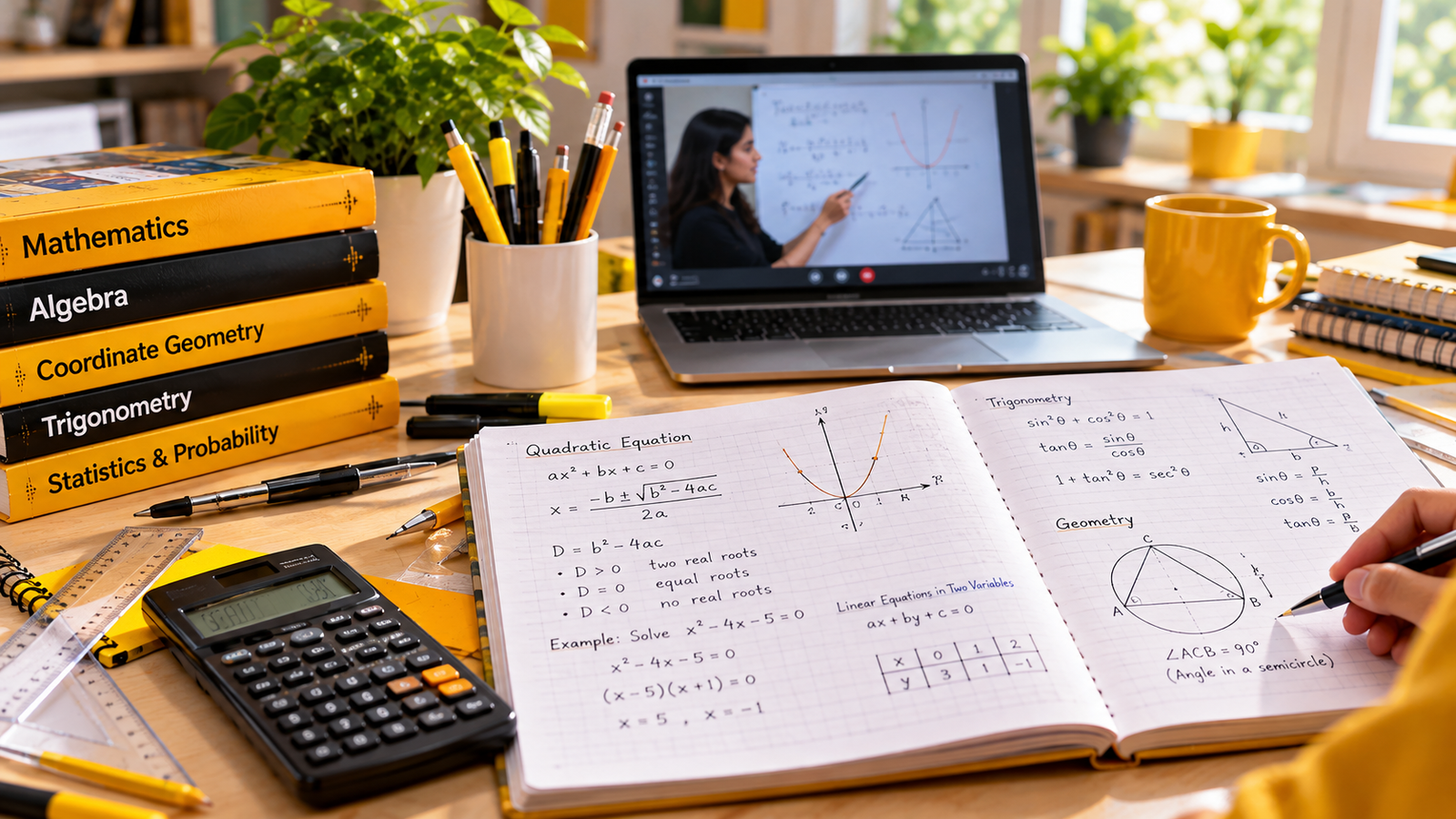
Why Choose an Online Class 10 Maths Tutor?
Mathematics topics build on one another. If a student is unsure about fractions, algebraic manipulation or basic equations, later chapters can feel much harder than they need to. Focused support helps students find the exact step where their understanding breaks down and rebuild it before moving forward.
Online learning can make regular tuition more convenient by reducing travel time and allowing students to learn from home. The most effective lessons still require active participation: the learner should solve questions, explain their reasoning, ask questions when stuck and complete independent practice between sessions.
- Concept clarity: understand methods instead of memorising steps without context.
- Step-by-step solutions: learn how to show working clearly and logically.
- Targeted practice: spend more time on weak topics and less on already secure skills.
- Exam readiness: practise different question styles and manage time effectively.
- Progress review: use quizzes and error analysis to guide the next lesson.
One-to-One Live Maths Classes
One-to-one tutoring can be useful when a student needs a personalised pace, repeated explanation or a plan focused on specific chapters. A tutor may begin with a short diagnostic set, observe the student’s method, explain a concept, solve one example together and then ask the student to attempt a similar question independently.
For instance, a student who struggles with quadratic equations may need to revisit factorisation before learning how to solve more complex examples. A student who loses marks in geometry may understand the theorem but fail to identify which information in the question makes it applicable. Individual sessions can focus on the specific gap instead of treating every chapter equally.
One-to-one lessons are not a substitute for independent work. Students should try the homework without immediately checking the answer, note where they become stuck and bring those questions to the next class. This gives the tutor evidence about what has been understood and what still needs attention.
Group Live Maths Classes
Group classes can provide a consistent timetable and opportunities to hear alternative solution methods. Learners can compare approaches, practise explaining their reasoning and learn from common mistakes discussed during the session. Before enrolling, confirm the batch size, subject coverage, timetable and how individual doubts are handled.
A structured group lesson should include a brief recap, explanation of the main idea, guided examples, independent practice and a summary of frequent errors. Students should participate rather than only watch the tutor solve questions. If a learner needs extended personal attention on foundational skills, ask whether one-to-one lessons would be a better fit.
Important Class 10 Maths Topics to Practise
Use the syllabus for the student’s current board and academic session to decide which chapters are included. The following topic areas commonly appear in Class 10 Mathematics courses, but students should always verify the exact chapter list and assessment requirements with their school and official board resources.
Real numbers
Practise identifying relevant properties and writing each step clearly. When working with prime factorisation or proofs, explain why a step follows instead of skipping straight to the result. Review divisibility, factors and the notation used in the prescribed textbook.
Polynomials
Connect the zeros of a polynomial with its graph and coefficients where required by the syllabus. For questions involving relationships between zeros and coefficients, write the formula first, substitute values carefully and check signs. Avoid confusing a zero of a polynomial with the value of the polynomial at an arbitrary point.
Pair of linear equations in two variables
Learn how graphical, substitution, elimination and other syllabus-prescribed methods relate to the same system. Choose a method that fits the coefficients, keep the equations aligned and verify a solution in both original equations. Word problems should begin with clearly defined variables and equations that match the information given.
Quadratic equations
Practise factorisation, completing the square or the quadratic formula as applicable. Before choosing a method, place the equation in the correct standard form and identify the coefficients, including negative signs. After solving, substitute the roots into the original equation when practical to check the result.
Arithmetic progressions
Identify the first term, common difference and term number before selecting a formula. In word problems, explain what the terms represent and check that the calculated number of terms makes sense. Be careful when translating everyday language such as “every month” or “each row” into a sequence model.
Triangles and coordinate geometry
For geometry proofs, write the given information, state the theorem being used and show how the conclusion follows. In coordinate geometry, record coordinates accurately and substitute them into the correct formula. A neat diagram can help organise the information, but a diagram alone does not prove a statement.
Trigonometry and applications
Learn the meanings of the trigonometric ratios and how they relate to the sides of a right triangle. Draw a labelled diagram for height-and-distance questions, mark the angle of elevation or depression and identify the opposite, adjacent and hypotenuse sides relative to the chosen angle. Use only the ratios and identities included in the current syllabus.
Circles, areas and mensuration
For tangent questions, identify the relevant radius, tangent and point of contact before applying a theorem. In area and volume problems, list the dimensions with units, select the correct formula and check whether the question asks for a curved surface area, total surface area or volume. Convert units before calculating when necessary.
Statistics and probability
Read tables and frequency information carefully. Write down the values and frequencies before substituting them into a formula. For probability questions, define the possible outcomes and distinguish favourable outcomes from total equally likely outcomes. Do not assume outcomes are equally likely unless the question or model supports that assumption.
How to Solve Maths Questions Step by Step
A reliable solution process reduces careless mistakes and makes working easier to review. First, read the question twice and underline what must be found. Next, write the relevant information, define variables if the problem is in words and identify the concept or theorem that connects the known information to the unknown.
- Understand: identify what is given, what is asked and any restrictions.
- Plan: select a formula, theorem or method and briefly state why it applies.
- Solve: show each important algebraic step and keep the working organised.
- Check: substitute the answer where possible, review signs and confirm units.
- Communicate: write the final answer clearly and include the requested reasoning.
When a solution goes wrong, do not simply copy the correct answer. Compare your steps with the model solution and locate the first incorrect line. Was a negative sign lost? Was a formula selected incorrectly? Did the equation fail to represent the word problem? Fixing the cause is more useful than memorising the final result.
How to Make Useful Maths Notes
Maths notes should be concise and practical. Keep formulas, conditions, one worked example and common errors together for each topic. Write the reason for using a method in your own words. For example, next to a quadratic formula, note when the equation must first be rearranged into standard form and how the discriminant affects the roots if that is part of your syllabus.
- Maintain a formula sheet and review it from memory.
- Keep a theorem list with a short explanation of when each theorem applies.
- Record one example that demonstrates the method, not ten identical examples.
- Maintain an error log with the date, topic, mistake and correction.
- Revisit older topics at intervals instead of revising only the latest chapter.
Keep the notebook readable, but do not spend so long decorating it that you lose time for solving problems. Writing a solution independently is the main test of whether a method has been learned.
A Weekly Study Plan for Class 10 Mathematics
Adapt the example below to school hours, homework, the current syllabus and upcoming tests. Short, consistent practice is usually easier to sustain than a very long session once a week.
| Day | Focus | Suggested task |
|---|---|---|
| Monday | Algebra | Solve a mixed set on the current algebra chapter |
| Tuesday | Geometry | Write proofs and practise theorem-based questions |
| Wednesday | Trigonometry | Review identities and solve application questions |
| Thursday | Mensuration or coordinate geometry | Practise formula selection and careful substitutions |
| Friday | Statistics and probability | Complete data-based and reasoning questions |
| Saturday | Mixed assessment | Attempt a timed section and mark it honestly |
| Sunday | Correction and recap | Retry mistakes and plan the next week’s priorities |
Preparing for School Tests and Board Examinations
Start by checking the latest syllabus, examination pattern and instructions for the applicable academic session. Use the prescribed textbook and school guidance as the foundation. Practise different types of questions, including short calculations, reasoning, proofs, application problems and longer multi-step questions where relevant.
When attempting a practice paper, follow the time limit and avoid checking solutions during the attempt. After marking it, classify mistakes: concept gap, incorrect formula, algebraic error, misread question, missing working or time management. Use this classification to plan revision. If most errors are algebraic, more reading will not solve the problem; the student needs carefully checked algebra practice.
Official resources can help students verify curriculum information. Visit the CBSE Academic website for relevant curriculum and assessment notices, and NCERT for textbooks and learning resources. Students following ICSE, a state board or another curriculum should consult that board’s official materials and school instructions.
Common Maths Mistakes to Avoid
- Skipping steps: show enough working to make the reasoning clear and catch errors early.
- Ignoring signs: check negative values carefully during substitution and factorisation.
- Using a formula without checking conditions: identify the quantities and assumptions before applying it.
- Memorising proofs: understand the theorem and the logical link between each statement.
- Practising only easy questions: gradually add unfamiliar and multi-step problems.
- Leaving corrections unfinished: retry wrong questions later without looking at the solution.
- Ignoring units and labels: include the requested units and clearly label diagrams where relevant.
How Parents Can Support Maths Improvement
Parents can help by providing a quiet study space, supporting a realistic timetable and asking the student to explain the method used rather than only checking whether homework is complete. Keep the focus on progress and problem-solving habits, not just the score on one test. If a student is repeatedly stuck, ask which step is confusing and communicate that specific issue to the teacher or tutor.
When choosing online tuition, ask how the tutor diagnoses gaps, assigns practice, checks homework and communicates progress. Confirm that the lessons match the student’s board and current syllabus. A good tutoring fit depends on teaching style, schedule, learner needs and regular feedback. No tutor or programme can honestly guarantee a particular mark for every student.
What to Expect from an Online Maths Lesson
A well-structured lesson can include a quick recap, a short diagnostic question, concept explanation, guided examples, independent problem-solving and a final review. Students should finish with a clear understanding of what was covered and what to practise before the next class.
Before class, keep the textbook, notebook, calculator when permitted, and questions ready. If a step is unclear, ask the tutor to explain the reasoning or demonstrate a second example. During independent practice, attempt each question before checking the solution. This helps the tutor see the student’s own thinking rather than only the answer they copied.
How to Handle Different Maths Question Types
Read the command word carefully. “Solve” generally requires a complete method and result; “prove” requires a logical argument; “find” or “calculate” asks for a value and usually enough working to show how it was obtained; “verify” requires checking a statement using the relevant expressions. If the question asks for a graph, label axes and plot points accurately. If it asks for a reason, include the mathematical justification rather than only a number.
For word problems, define the variables before forming equations. For geometry, draw a labelled figure and identify the theorem that connects the given information to the required result. For data questions, inspect the table headings and units before applying a formula. These small habits help ensure that the solution answers the question that was actually asked.
Use Active Recall and Spaced Practice
Rereading worked examples can create a feeling of familiarity without proving that a student can solve a question independently. After reviewing a method, close the book and recreate the steps from memory. Then solve a new question without looking at the example, check the result and correct any errors.
Return to the same topic after a gap, such as a few days later, and test yourself again. Mix older topics into weekly practice so that formulas and methods remain available when questions combine concepts. If a topic repeatedly causes errors, break it into smaller skills and practise the missing prerequisite before attempting the full problem.
Track Progress and Turn Mistakes into a Plan
Keep a simple progress sheet with the topic, date, question type, result and main mistake. Do not rely on marks alone. A student may answer familiar questions correctly but still struggle with unfamiliar applications, so include varied questions and review the reasoning used.
At the end of each week, look for patterns. If factorisation errors are common, practise the algebraic basics. If geometry proofs lack justification, review theorem statements and the reason for each step. If time runs out, practise timed sections after accuracy improves. Share the pattern with the tutor so future lessons can focus on a specific, measurable learning goal.
Frequently Asked Questions
Can I learn Class 10 Maths online?
Yes. Live online lessons can explain concepts, demonstrate worked examples and provide guided practice. Progress depends on regular attendance, active participation and independent problem-solving between classes.
Is one-to-one or group tuition better?
One-to-one lessons can focus on individual gaps and pace. Group classes can provide structured practice and discussion. Choose according to the student’s confidence, learning needs, timetable and preference for individual feedback.
How much should I practise Maths each day?
Set a realistic routine that fits school and homework. Short, focused practice on most days can help build consistency. Adjust the duration based on the syllabus, current understanding and upcoming assessments.
How can I reduce calculation mistakes?
Write steps clearly, keep signs aligned, avoid mental jumps in multi-step calculations and check the result by substitution or estimation where possible. Keep a record of recurring errors and practise those skills deliberately.
How should I revise formulas?
Review formulas from memory, note what each symbol means and solve a question that uses each formula. Also learn the conditions under which a formula applies so you can select it correctly.
Where can I check the CBSE Mathematics syllabus?
Visit the official CBSE Academic website and select the relevant academic session. Follow your school for the exact syllabus and assessment instructions.
Does The Infinity provide free study material?
Visit The Infinity Live to explore online learning and available study resources. Check the platform for current access details and availability.
Start Class 10 Maths Preparation with The Infinity
Build a steady routine with clear explanations, guided questions and regular revision. The Infinity Home Tuitions offers online learning options for students who want support with school Mathematics. Before starting, share the learner’s board, current chapters, preferred schedule and topics that feel difficult so the learning plan can be focused.
Build Confidence in Class 10 Maths
Explore one-to-one live classes and group live classes, and check out free study material to support your preparation.
EXPLORE ONLINE CLASSES & FREE STUDY MATERIAL
Visit https://theinfinity.live to get started.
Study guidance should be adapted to the current syllabus, school instructions and individual learning needs. No tutoring format can guarantee a particular examination result.