Looking for an online Mathematics tutor for Class 2? The Infinity Home Tuitions offers personalised online live learning designed around a young child’s school syllabus, learning pace and current skills. Class 2 is an important stage for strengthening early foundations, developing curiosity and building confidence with classroom learning. Supportive tuition should feel structured, interactive and age-appropriate.
This guide explains how online Mathematics tuition can support Class 2 learners across CBSE, ICSE and other school curricula. Topic order and textbook expectations differ between schools, so the tutor should follow the child’s actual school books, teacher guidance and learning requirements instead of assuming that every school uses the same sequence.
Class 2 learning goals and essential foundations

At the beginning of Class 2, children benefit from lessons that build on familiar ideas and introduce new skills in manageable steps. A tutor first checks the learner’s starting point, listens to how the child explains an answer and notices where a prompt or demonstration is needed. The aim is to develop understanding, not simply to finish a worksheet. Short explanations, repetition with variety and encouragement help a young learner participate actively.
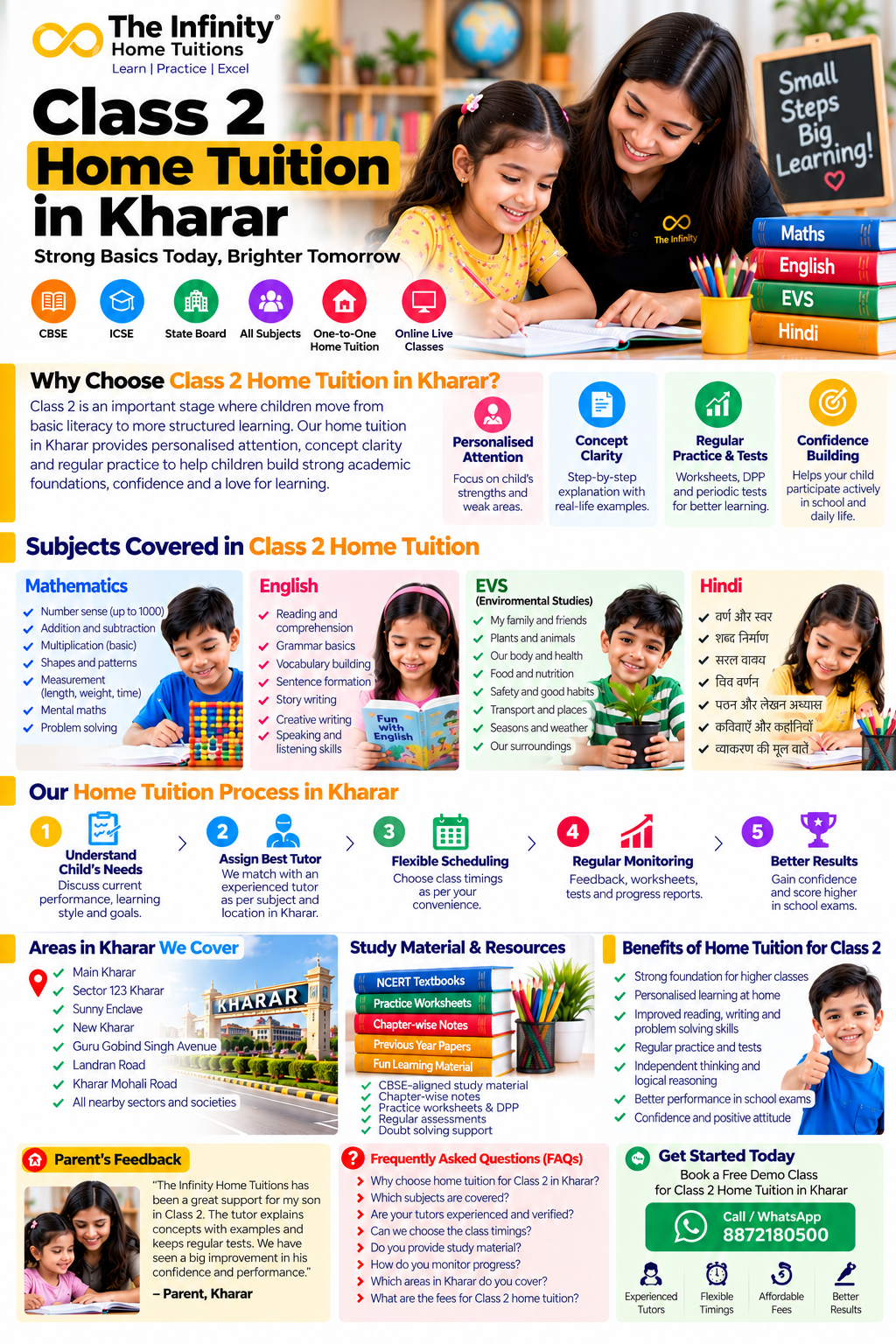
For counting, number names, place value, addition, subtraction, simple multiplication, shapes, patterns, measurement, time and money, the tutor can use everyday examples, pictures, objects, short stories and simple questions. Connecting a lesson to a child’s home and school experiences makes unfamiliar vocabulary easier to understand. The learner should have time to observe, speak, try, make mistakes and try again. Asking the child to explain an idea in their own words is a useful way to check whether the concept has become meaningful.
A balanced session can include a short warm-up, one main learning objective, guided practice, an independent attempt and a brief recap. The tutor should adjust the pace according to attention and understanding, rather than expecting every child to learn in exactly the same way. Small achievable steps create opportunities for success while still providing an appropriate challenge.
Parents can reinforce learning through a calm daily routine: a few minutes of reading, a quick review of the day’s idea or a conversation about what the child found interesting. Praise effort, careful thinking and improvement. If a learner repeatedly struggles with a skill, share that observation with the tutor so the next lesson can revisit the foundation instead of adding more pressure.
The learning plan can cover counting, number names, place value, addition, subtraction, simple multiplication, shapes, patterns, measurement, time and money through short tasks selected for a Class 2 learner. The tutor should make the connection between the example and the school topic explicit, then invite the child to demonstrate the skill without copying the model answer.
Introducing new concepts in small, clear steps
At the beginning of Class 2, children benefit from lessons that build on familiar ideas and introduce new skills in manageable steps. A tutor first checks the learner’s starting point, listens to how the child explains an answer and notices where a prompt or demonstration is needed. The aim is to develop understanding, not simply to finish a worksheet. Short explanations, repetition with variety and encouragement help a young learner participate actively.
For counting, number names, place value, addition, subtraction, simple multiplication, shapes, patterns, measurement, time and money, the tutor can use everyday examples, pictures, objects, short stories and simple questions. Connecting a lesson to a child’s home and school experiences makes unfamiliar vocabulary easier to understand. The learner should have time to observe, speak, try, make mistakes and try again. Asking the child to explain an idea in their own words is a useful way to check whether the concept has become meaningful.
A balanced session can include a short warm-up, one main learning objective, guided practice, an independent attempt and a brief recap. The tutor should adjust the pace according to attention and understanding, rather than expecting every child to learn in exactly the same way. Small achievable steps create opportunities for success while still providing an appropriate challenge.
Parents can reinforce learning through a calm daily routine: a few minutes of reading, a quick review of the day’s idea or a conversation about what the child found interesting. Praise effort, careful thinking and improvement. If a learner repeatedly struggles with a skill, share that observation with the tutor so the next lesson can revisit the foundation instead of adding more pressure.
Learning through stories, examples and activities

At the beginning of Class 2, children benefit from lessons that build on familiar ideas and introduce new skills in manageable steps. A tutor first checks the learner’s starting point, listens to how the child explains an answer and notices where a prompt or demonstration is needed. The aim is to develop understanding, not simply to finish a worksheet. Short explanations, repetition with variety and encouragement help a young learner participate actively.
For counting, number names, place value, addition, subtraction, simple multiplication, shapes, patterns, measurement, time and money, the tutor can use everyday examples, pictures, objects, short stories and simple questions. Connecting a lesson to a child’s home and school experiences makes unfamiliar vocabulary easier to understand. The learner should have time to observe, speak, try, make mistakes and try again. Asking the child to explain an idea in their own words is a useful way to check whether the concept has become meaningful.
A balanced session can include a short warm-up, one main learning objective, guided practice, an independent attempt and a brief recap. The tutor should adjust the pace according to attention and understanding, rather than expecting every child to learn in exactly the same way. Small achievable steps create opportunities for success while still providing an appropriate challenge.
Parents can reinforce learning through a calm daily routine: a few minutes of reading, a quick review of the day’s idea or a conversation about what the child found interesting. Praise effort, careful thinking and improvement. If a learner repeatedly struggles with a skill, share that observation with the tutor so the next lesson can revisit the foundation instead of adding more pressure.
Developing vocabulary and confidence

At the beginning of Class 2, children benefit from lessons that build on familiar ideas and introduce new skills in manageable steps. A tutor first checks the learner’s starting point, listens to how the child explains an answer and notices where a prompt or demonstration is needed. The aim is to develop understanding, not simply to finish a worksheet. Short explanations, repetition with variety and encouragement help a young learner participate actively.
For counting, number names, place value, addition, subtraction, simple multiplication, shapes, patterns, measurement, time and money, the tutor can use everyday examples, pictures, objects, short stories and simple questions. Connecting a lesson to a child’s home and school experiences makes unfamiliar vocabulary easier to understand. The learner should have time to observe, speak, try, make mistakes and try again. Asking the child to explain an idea in their own words is a useful way to check whether the concept has become meaningful.
A balanced session can include a short warm-up, one main learning objective, guided practice, an independent attempt and a brief recap. The tutor should adjust the pace according to attention and understanding, rather than expecting every child to learn in exactly the same way. Small achievable steps create opportunities for success while still providing an appropriate challenge.
Parents can reinforce learning through a calm daily routine: a few minutes of reading, a quick review of the day’s idea or a conversation about what the child found interesting. Praise effort, careful thinking and improvement. If a learner repeatedly struggles with a skill, share that observation with the tutor so the next lesson can revisit the foundation instead of adding more pressure.
Guided practice and independent learning
At the beginning of Class 2, children benefit from lessons that build on familiar ideas and introduce new skills in manageable steps. A tutor first checks the learner’s starting point, listens to how the child explains an answer and notices where a prompt or demonstration is needed. The aim is to develop understanding, not simply to finish a worksheet. Short explanations, repetition with variety and encouragement help a young learner participate actively.
For counting, number names, place value, addition, subtraction, simple multiplication, shapes, patterns, measurement, time and money, the tutor can use everyday examples, pictures, objects, short stories and simple questions. Connecting a lesson to a child’s home and school experiences makes unfamiliar vocabulary easier to understand. The learner should have time to observe, speak, try, make mistakes and try again. Asking the child to explain an idea in their own words is a useful way to check whether the concept has become meaningful.
A balanced session can include a short warm-up, one main learning objective, guided practice, an independent attempt and a brief recap. The tutor should adjust the pace according to attention and understanding, rather than expecting every child to learn in exactly the same way. Small achievable steps create opportunities for success while still providing an appropriate challenge.
Parents can reinforce learning through a calm daily routine: a few minutes of reading, a quick review of the day’s idea or a conversation about what the child found interesting. Praise effort, careful thinking and improvement. If a learner repeatedly struggles with a skill, share that observation with the tutor so the next lesson can revisit the foundation instead of adding more pressure.
Recognising common difficulties early
At the beginning of Class 2, children benefit from lessons that build on familiar ideas and introduce new skills in manageable steps. A tutor first checks the learner’s starting point, listens to how the child explains an answer and notices where a prompt or demonstration is needed. The aim is to develop understanding, not simply to finish a worksheet. Short explanations, repetition with variety and encouragement help a young learner participate actively.
For counting, number names, place value, addition, subtraction, simple multiplication, shapes, patterns, measurement, time and money, the tutor can use everyday examples, pictures, objects, short stories and simple questions. Connecting a lesson to a child’s home and school experiences makes unfamiliar vocabulary easier to understand. The learner should have time to observe, speak, try, make mistakes and try again. Asking the child to explain an idea in their own words is a useful way to check whether the concept has become meaningful.
A balanced session can include a short warm-up, one main learning objective, guided practice, an independent attempt and a brief recap. The tutor should adjust the pace according to attention and understanding, rather than expecting every child to learn in exactly the same way. Small achievable steps create opportunities for success while still providing an appropriate challenge.
Parents can reinforce learning through a calm daily routine: a few minutes of reading, a quick review of the day’s idea or a conversation about what the child found interesting. Praise effort, careful thinking and improvement. If a learner repeatedly struggles with a skill, share that observation with the tutor so the next lesson can revisit the foundation instead of adding more pressure.
Building positive homework and revision habits
At the beginning of Class 2, children benefit from lessons that build on familiar ideas and introduce new skills in manageable steps. A tutor first checks the learner’s starting point, listens to how the child explains an answer and notices where a prompt or demonstration is needed. The aim is to develop understanding, not simply to finish a worksheet. Short explanations, repetition with variety and encouragement help a young learner participate actively.
For counting, number names, place value, addition, subtraction, simple multiplication, shapes, patterns, measurement, time and money, the tutor can use everyday examples, pictures, objects, short stories and simple questions. Connecting a lesson to a child’s home and school experiences makes unfamiliar vocabulary easier to understand. The learner should have time to observe, speak, try, make mistakes and try again. Asking the child to explain an idea in their own words is a useful way to check whether the concept has become meaningful.
A balanced session can include a short warm-up, one main learning objective, guided practice, an independent attempt and a brief recap. The tutor should adjust the pace according to attention and understanding, rather than expecting every child to learn in exactly the same way. Small achievable steps create opportunities for success while still providing an appropriate challenge.
Parents can reinforce learning through a calm daily routine: a few minutes of reading, a quick review of the day’s idea or a conversation about what the child found interesting. Praise effort, careful thinking and improvement. If a learner repeatedly struggles with a skill, share that observation with the tutor so the next lesson can revisit the foundation instead of adding more pressure.
Checking understanding and celebrating progress
At the beginning of Class 2, children benefit from lessons that build on familiar ideas and introduce new skills in manageable steps. A tutor first checks the learner’s starting point, listens to how the child explains an answer and notices where a prompt or demonstration is needed. The aim is to develop understanding, not simply to finish a worksheet. Short explanations, repetition with variety and encouragement help a young learner participate actively.
For counting, number names, place value, addition, subtraction, simple multiplication, shapes, patterns, measurement, time and money, the tutor can use everyday examples, pictures, objects, short stories and simple questions. Connecting a lesson to a child’s home and school experiences makes unfamiliar vocabulary easier to understand. The learner should have time to observe, speak, try, make mistakes and try again. Asking the child to explain an idea in their own words is a useful way to check whether the concept has become meaningful.
A balanced session can include a short warm-up, one main learning objective, guided practice, an independent attempt and a brief recap. The tutor should adjust the pace according to attention and understanding, rather than expecting every child to learn in exactly the same way. Small achievable steps create opportunities for success while still providing an appropriate challenge.
Parents can reinforce learning through a calm daily routine: a few minutes of reading, a quick review of the day’s idea or a conversation about what the child found interesting. Praise effort, careful thinking and improvement. If a learner repeatedly struggles with a skill, share that observation with the tutor so the next lesson can revisit the foundation instead of adding more pressure.
How personalised online lessons support young learners

At the beginning of Class 2, children benefit from lessons that build on familiar ideas and introduce new skills in manageable steps. A tutor first checks the learner’s starting point, listens to how the child explains an answer and notices where a prompt or demonstration is needed. The aim is to develop understanding, not simply to finish a worksheet. Short explanations, repetition with variety and encouragement help a young learner participate actively.
For counting, number names, place value, addition, subtraction, simple multiplication, shapes, patterns, measurement, time and money, the tutor can use everyday examples, pictures, objects, short stories and simple questions. Connecting a lesson to a child’s home and school experiences makes unfamiliar vocabulary easier to understand. The learner should have time to observe, speak, try, make mistakes and try again. Asking the child to explain an idea in their own words is a useful way to check whether the concept has become meaningful.
A balanced session can include a short warm-up, one main learning objective, guided practice, an independent attempt and a brief recap. The tutor should adjust the pace according to attention and understanding, rather than expecting every child to learn in exactly the same way. Small achievable steps create opportunities for success while still providing an appropriate challenge.
Parents can reinforce learning through a calm daily routine: a few minutes of reading, a quick review of the day’s idea or a conversation about what the child found interesting. Praise effort, careful thinking and improvement. If a learner repeatedly struggles with a skill, share that observation with the tutor so the next lesson can revisit the foundation instead of adding more pressure.
Choosing the right online tutor for Class 2
At the beginning of Class 2, children benefit from lessons that build on familiar ideas and introduce new skills in manageable steps. A tutor first checks the learner’s starting point, listens to how the child explains an answer and notices where a prompt or demonstration is needed. The aim is to develop understanding, not simply to finish a worksheet. Short explanations, repetition with variety and encouragement help a young learner participate actively.
For counting, number names, place value, addition, subtraction, simple multiplication, shapes, patterns, measurement, time and money, the tutor can use everyday examples, pictures, objects, short stories and simple questions. Connecting a lesson to a child’s home and school experiences makes unfamiliar vocabulary easier to understand. The learner should have time to observe, speak, try, make mistakes and try again. Asking the child to explain an idea in their own words is a useful way to check whether the concept has become meaningful.
A balanced session can include a short warm-up, one main learning objective, guided practice, an independent attempt and a brief recap. The tutor should adjust the pace according to attention and understanding, rather than expecting every child to learn in exactly the same way. Small achievable steps create opportunities for success while still providing an appropriate challenge.
Parents can reinforce learning through a calm daily routine: a few minutes of reading, a quick review of the day’s idea or a conversation about what the child found interesting. Praise effort, careful thinking and improvement. If a learner repeatedly struggles with a skill, share that observation with the tutor so the next lesson can revisit the foundation instead of adding more pressure.
What happens in an online Class 2 lesson?
A well-run online session is interactive rather than a long lecture. The tutor explains, asks questions, uses visual prompts and gives the learner time to respond. Depending on the child’s needs and the available programme, lessons may be one-to-one or in a small group. The learning objective and expected practice should be clear before the session ends.
For younger learners, parents can help by arranging a quiet space, checking the device and being available for basic technical support. The tutor should keep the child engaged through varied activities and appropriate breaks. Online tuition is most effective when it complements school teaching and encourages the child to attempt tasks independently.
Frequently asked questions about Class 2 Mathematics tuition
Is online tuition suitable for a Class 2 child?
It can be suitable when lessons are age-appropriate, interactive and supported by a quiet learning space and a reliable device. Parents should consider the child’s comfort with screen-based learning and the session format.
Can the tutor follow my child’s school board?
Yes, the lesson plan can be adapted after reviewing the actual school textbook, syllabus and teacher’s instructions for CBSE, ICSE or another curriculum.
How long should a Class 2 lesson be?
Lesson duration should reflect the child’s attention, schedule and learning objective. A tutor can suggest a suitable format after understanding the learner’s needs.
How can parents track improvement?
Look for stronger confidence, improved accuracy, clearer explanations and greater independence. Ask for periodic updates on skills practised and areas to revisit.
Will the tutor complete school homework?
The tutor can explain instructions, model a similar example and guide practice, but the child should complete their own work to develop understanding and independence.
Enquire about an online Class 2 Mathematics tutor
Share the child’s board, school syllabus, preferred timings and learning goals with The Infinity Home Tuitions. Visit The Infinity Home Tuitions, explore online live learning at The Infinity Live, follow the WhatsApp channel or view The Infinity learning app.
Help your child build strong foundations with patient explanations, regular practice and personalised learning support. Contact The Infinity Home Tuitions to discuss suitable tuition options.