CBSE 2026–27 is changing what “being prepared for school” means. With Computational Thinking (CT) and Understanding Artificial Intelligence (AI) introduced for Classes 3 to 8, students are being encouraged to develop logical reasoning, systematic problem-solving, pattern recognition, algorithmic thinking, data awareness and responsible use of technology. The change is bigger than learning a new computer topic. It points toward a broader shift in how students are expected to think, learn and solve problems.
For parents, the most important question is not simply, “Does my child need to learn AI?” A better question is: “How should my child study differently in 2026–27 so that strong school fundamentals and new-age skills develop together?”
This guide explains that change in practical terms. It looks at Mathematics, Science, homework, projects, revision, assessment, digital tools, AI ethics, parent support and the role of teachers and tutors. It is designed for parents and students in Chandigarh, Panchkula, Mohali, Zirakpur, Kharar and nearby areas, as well as families using online tuition.
Quick Answer: What Does the CBSE 2026–27 AI and Computational Thinking Change Mean?
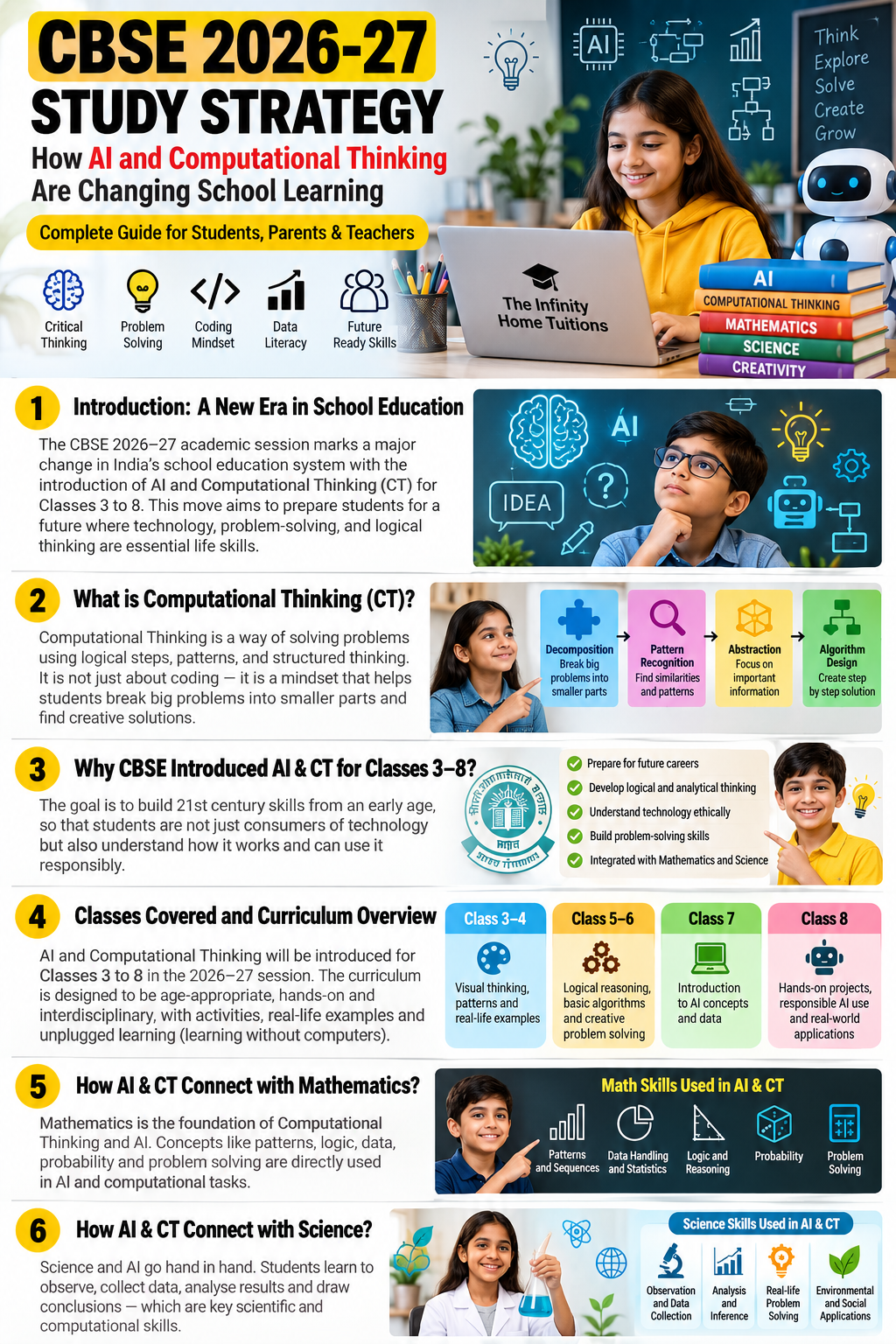
CBSE has introduced a curriculum on Computational Thinking and Understanding Artificial Intelligence for Classes 3 to 8 from the 2026–27 academic session. The official CBSE material describes goals including logical thinking, systematic problem-solving, finding patterns, AI readiness and ethical use of AI. CBSE also describes CT and AI as interdisciplinary themes that can connect with Mathematics, Science, Social Sciences and languages.
The practical implication is important: students do not need to become programmers simply because AI is entering school education. Instead, they need to become better thinkers. They should learn how to break a difficult problem into smaller parts, identify information that matters, recognise patterns, create a sequence of steps, test an answer, identify mistakes and explain their reasoning.
Mathematics therefore becomes even more important. Science becomes more connected to evidence, models and problem-solving. Language skills matter because students must understand instructions and communicate reasoning. Digital literacy matters because students need to understand the limitations and responsible use of AI systems.
CBSE’s official April 2026 circular also describes the curriculum as combining CT, AI, ethics and unplugged learning, with examples involving decomposition, pattern identification, algorithms, data-driven decision-making, bias and fairness. The board’s training notification identifies Mathematics as a cornerstone of CT and AI readiness.
1. The Real Trend: From Memorising Answers to Building Thinking Skills
For many years, school preparation has often been associated with completing chapters, memorising definitions, practising textbook questions and preparing for examinations. Those activities remain important, but the educational direction is increasingly asking students to demonstrate understanding rather than only reproduce information.
Computational thinking reinforces this change. A student who can memorise a formula but cannot decide which formula to use has a weaker problem-solving foundation than a student who understands the structure of the problem. Similarly, a child who can copy a science definition but cannot explain why an experiment produces a particular result has not fully developed conceptual understanding.
This does not mean that memorisation has become useless. Facts, vocabulary, formulas, definitions and foundational knowledge still matter. Thinking skills work on top of knowledge. A student cannot reason effectively about fractions without understanding fractions, or analyse a physics problem without understanding the relevant concepts.
The stronger 2026–27 study model is therefore:
- Learn the concept.
- Understand why it works.
- Practise guided examples.
- Solve unfamiliar problems.
- Explain the reasoning.
- Review mistakes.
- Apply the idea in a new situation.
This approach is useful whether a student is studying at school, with a home tutor, through online one-to-one tuition or in a small coaching group.
2. What Is Computational Thinking in Simple Language?
Computational thinking does not mean “thinking like a computer” in a literal sense. It is a way of approaching problems systematically. A computer can execute instructions, but a human learner must first understand the problem, decide what information matters and design a sensible process.
Several recurring skills are especially useful:
Decomposition
Decomposition means breaking a large problem into smaller, manageable parts. Suppose a student is asked to solve a multi-step Mathematics word problem. Instead of attempting the entire question at once, the student can identify the known information, determine what is being asked, select intermediate quantities and then solve step by step.
Pattern Recognition
Pattern recognition means identifying relationships that repeat. It appears everywhere in Mathematics and Science. Number sequences, geometric relationships, algebraic expressions, data tables and scientific observations can all contain patterns.
Abstraction
Abstraction means focusing on the information that matters for a particular problem while ignoring unnecessary details. This is a powerful examination skill. Students often lose time because they treat every sentence in a question as equally important.
Algorithms and Step-by-Step Thinking
An algorithm is essentially a sequence of steps used to achieve an outcome. Students already use algorithms in everyday life without calling them algorithms: following a recipe, solving long division, arranging information or completing a scientific procedure.
Evaluation and Debugging
Students should learn to ask: “Where did my solution go wrong?” This is similar to debugging. A wrong answer is not simply a failure; it is information about the reasoning process. Checking units, signs, calculations, assumptions and intermediate steps can reveal the source of an error.
3. Why Mathematics Becomes Even More Important
One of the clearest messages in the CBSE material is the connection between Mathematics and computational thinking. The board’s 2026–27 training material explicitly identifies Mathematics as a cornerstone of computational thinking and AI readiness.
This makes sense because Mathematics trains several habits that are useful for AI and computational reasoning: logical sequencing, quantitative comparison, pattern recognition, abstraction, probability, data interpretation and problem-solving.
For younger students, this does not mean turning Mathematics into advanced programming. It means strengthening mathematical thinking through puzzles, games, patterns, reasoning questions, estimation, measurement and structured problem-solving.
For Classes 6 to 8, students can gradually work with more complex patterns, ratios, proportional reasoning, number systems, geometry, data and multi-step problems. The aim should be to understand the reasoning behind a method rather than memorise a procedure without understanding it.
For parents, this creates a useful priority: if a child is struggling with Mathematics fundamentals, adding more AI tools may not solve the underlying problem. Strengthening number sense, fractions, algebraic reasoning, geometry and data interpretation can provide a much stronger foundation.
4. Why Science Also Changes Under a Thinking-Skills Approach
Science education naturally involves observation, evidence, hypotheses, models and explanations. Computational thinking can strengthen these habits.
Consider a simple Science question. A student may know the definition of evaporation. But deeper learning asks the student to explain which factors influence evaporation, predict what happens when one variable changes, interpret observations and connect the result with a real-world situation.
That is a reasoning process.
Similarly, in Physics, students need to understand relationships between quantities rather than simply substitute numbers into formulas. In Chemistry, they need to interpret reactions, observations and numerical relationships. In Biology, they increasingly need to connect structures, functions, processes and evidence.
A strong tutor or teacher should therefore ask questions such as:
- Why?
- How do you know?
- What would happen if this variable changed?
- Can you explain this in your own words?
- What is the first step?
- Can you find another method?
- Where could an error occur?
These questions build the same underlying habits that CT and AI education is trying to strengthen.
5. AI Should Support Learning, Not Replace Learning
One of the biggest questions for parents is whether students should use generative AI for homework. The answer should not be a simple “always use it” or “never use it.” The useful question is how the tool is being used.
If a student asks an AI system to produce an entire assignment and submits it without understanding the answer, the technology has replaced learning. If the student first attempts the problem, then uses AI to ask for another explanation, identify a conceptual gap or generate additional practice questions, the technology can support learning.
A practical rule is:
Think first. Attempt second. Use AI for support. Verify the result. Explain the answer yourself.
Students should also understand that AI systems can produce incorrect, incomplete or misleading information. An answer that sounds confident is not automatically correct. This is particularly important in Mathematics, Science, current affairs and factual research.
6. What Responsible AI Use Should Look Like for School Students
Responsible AI use includes more than avoiding plagiarism. Students should understand privacy, accuracy, bias, fairness, authorship and the difference between assistance and substitution.
Children should avoid entering sensitive personal information into AI systems. They should not assume that generated information is automatically authoritative. They should check important facts against textbooks, teachers, official websites and trusted educational sources.
Students should also be transparent when school rules require disclosure of AI assistance. If a teacher asks for independent work, the student should follow that requirement.
Parents can teach a simple verification routine:
- What did I ask?
- What answer did I receive?
- Can I explain the answer without looking at the AI output?
- Can I verify important facts from a reliable source?
- Did the tool help me learn, or did it simply do the work for me?
7. How Homework Should Change in 2026–27
Homework should increasingly become an opportunity to practise thinking rather than simply produce pages of completed answers.
For Mathematics, students can attempt a problem independently, mark the point where they became uncertain and then ask for help. For Science, students can write a prediction before looking at the explanation. For languages, they can draft their own response before using digital tools for proofreading.
Parents should resist the temptation to complete homework for children. The objective is not a perfect notebook at any cost. The objective is an independent learner who gradually requires less assistance.
A useful home routine is:
- 10 minutes: review what was taught at school.
- 20–30 minutes: independent practice.
- 10 minutes: correct mistakes.
- 10 minutes: explain one difficult concept aloud.
- Optional: use an approved digital tool for additional practice or clarification.
The exact duration should be adapted to the student’s age and school workload. Younger children generally benefit more from shorter, focused sessions than from very long study periods.
8. A Better Study Cycle for Classes 3 to 5
For primary-stage learners, the focus should remain on curiosity, language, mathematical foundations and simple logical thinking.
Parents can encourage children to classify objects, identify patterns, sequence events, follow instructions, create simple rules and explain why a choice was made.
Mathematics games can involve number patterns, estimation and logical puzzles. Science activities can involve observation and prediction. Language activities can ask students to arrange information, identify relationships or explain instructions.
At this stage, excessive screen time is unnecessary. Computational thinking can be taught through paper, cards, puzzles, classroom activities and everyday tasks. This is consistent with CBSE’s emphasis on age-appropriate and unplugged learning.
9. A Better Study Cycle for Classes 6 to 8
Middle-school students can handle more structured problem-solving. They can learn to represent information, analyse patterns, work with data, write step-by-step procedures and discuss the social implications of technology.
A strong weekly routine can include:
- Concept revision.
- Mixed problem-solving.
- One reasoning-based challenge.
- One data or graph interpretation task.
- One project or real-world application.
- Error analysis.
- Short oral explanation of a difficult concept.
This structure helps students move from “I know the chapter” to “I can use the chapter.”
10. How Parents Can Identify Whether a Child Really Understands a Topic
Marks provide useful information, but they do not always reveal the complete learning picture. Parents can use a simple five-question test.
- Can the child explain the concept without reading the textbook?
- Can the child solve a basic question independently?
- Can the child solve a slightly unfamiliar question?
- Can the child identify and correct an error?
- Can the child connect the concept with a real-life example?
If the answer is yes to most of these questions, conceptual understanding is probably developing. If the child can only reproduce a memorised answer, additional conceptual practice may be needed.
11. What Teachers and Tutors Should Do Differently
The introduction of CT and AI creates an opportunity for teachers and tutors to shift from answer delivery toward guided reasoning.
A tutor should not immediately solve every difficult problem. Instead, the tutor can ask a sequence of prompts: “What information do we have?” “What are we trying to find?” “Which concept is related?” “What would you try first?” “Why?”
This approach is particularly useful in home tuition because one-to-one teaching allows the tutor to observe exactly where the student becomes confused.
For students preparing for examinations, however, reasoning should be balanced with syllabus coverage and timed practice. A student cannot ignore examination requirements in the name of conceptual exploration. The strongest approach integrates both.
12. How to Use AI for Mathematics Practice
Students can use AI as a practice partner in several ways:
- Ask for a similar problem after solving a textbook question.
- Ask for a hint rather than the complete answer.
- Ask for a simpler explanation of a difficult concept.
- Ask for a step-by-step check after attempting a problem.
- Ask for common mistakes to watch for.
However, students should independently verify calculations. For important academic work, the textbook, teacher and official curriculum remain primary sources.
13. How to Use AI for Science Without Losing Conceptual Understanding
AI can help students compare explanations, create revision questions or generate examples. But students should still work from their prescribed curriculum and textbooks.
For example, after studying a chapter on electricity, a student could ask for five conceptual questions that test understanding rather than memorisation. The student can answer them first and then use a trusted teacher or resource to verify the responses.
For diagrams, experiments and numerical questions, students should practise independently. AI-generated material can contain errors, and a polished-looking explanation should never replace checking the actual curriculum.
14. Why Human Tutoring Still Matters in the AI Era
AI can generate explanations quickly, but effective teaching is not just information retrieval. A teacher observes a learner, identifies misconceptions, changes the explanation, notices hesitation, adjusts difficulty and provides accountability.
A child might repeatedly make a particular algebraic error. A human tutor can recognise the pattern across several questions and create a targeted exercise set. An AI system may provide useful feedback, but the human relationship, context and sustained accountability remain important.
This is why the rise of AI does not automatically make teachers or tutors less relevant. Instead, it can change what good tutoring looks like.
15. Home Tuition in Chandigarh, Panchkula and Mohali in the 2026–27 Context
Families looking for academic support should consider whether the tuition programme develops independence rather than dependence.
For students in Panchkula, Mohali, Chandigarh, Zirakpur and Kharar, a suitable tutor can provide structured subject support while helping students develop better study habits.
The Infinity Home Tuitions provides home tuition and online learning options across different school levels and boards. Parents can review the available home tuition and online tuition services according to the child’s class, subject, board and learning needs.
The right choice should be based on the student’s actual requirement. A child struggling with Mathematics fundamentals may need a different intervention from a student who understands concepts but needs examination practice. Similarly, a younger student may need confidence-building and structured routines rather than intensive coaching.
16. Home Tuition vs Online Tuition for the New Learning Environment
Both models can work. The important factor is quality and consistency.
Home tuition can be useful when a child needs close supervision, personalised pacing, direct notebook checking and a quiet one-to-one environment. Online tuition can be effective when the student is comfortable with digital learning, has reliable connectivity and benefits from access to online resources.
Small-group learning can provide peer interaction, while one-to-one tuition offers maximum individual attention.
The 2026–27 CT and AI trend does not make one format universally superior. Parents should choose the format that matches the child’s learning behaviour, academic level, schedule and specific difficulties.
17. How to Build a 30-Day Study Improvement Plan
A useful improvement plan does not need to be complicated.
Week 1: Diagnose
Identify the student’s strongest and weakest topics. Review recent tests and notebooks. Look for repeated mistakes rather than isolated errors.
Week 2: Rebuild Fundamentals
Relearn weak concepts using simple explanations. Complete basic and moderate questions before attempting difficult ones.
Week 3: Apply and Integrate
Use mixed questions that require the student to decide which method or concept is appropriate. Add reasoning and application questions.
Week 4: Test and Review
Conduct timed practice. Analyse every mistake. Categorise errors into conceptual, calculation, interpretation, careless or time-management problems.
This process builds the kind of self-monitoring that becomes increasingly valuable in an AI-supported learning environment.
18. The Importance of Error Logs
An error log is one of the simplest and most powerful study tools. Students can maintain a notebook or digital document with four columns: question, mistake, reason, corrected method.
| Question | Mistake | Reason | Correct Method |
|---|---|---|---|
| Algebra | Sign error | Skipped bracket check | Expand brackets before simplifying |
| Physics | Wrong unit | Did not convert cm to m | Check SI units before substitution |
| Science | Incomplete explanation | Memorised definition only | Explain cause and effect |
This is effectively a form of debugging. Students are learning to inspect the process, not merely celebrate the final answer.
19. Assessment in the New AI and CT Environment
As schools integrate computational thinking and AI concepts, assessment can increasingly include reasoning, application, projects, interpretation and explanation.
Parents should therefore avoid judging learning only by the number of pages completed. A better question is whether the child can transfer a concept to a new problem.
Teachers may also use projects and interdisciplinary activities. Students should learn to document their process, identify sources, explain decisions and distinguish their own work from machine-generated assistance.
20. Interdisciplinary Learning: Why Subjects Are Becoming More Connected
Real-world problems rarely fit neatly into one school subject. A water-management project can involve Mathematics, Science, Geography, language and data interpretation. A discussion of AI can involve computer science, mathematics, ethics, language and social studies.
CBSE’s CT/AI framework explicitly encourages interdisciplinary connections. This is important because it teaches students that knowledge is not a collection of isolated chapters.
For parents, interdisciplinary learning can be encouraged through everyday questions: How much water does the family use? How could the data be recorded? What pattern appears? How could usage be reduced? How would the result be communicated?
21. What Parents Should Avoid
- Do not make the child dependent on AI for every answer.
- Do not assume coding is the only form of AI education.
- Do not replace textbook learning with random internet content.
- Do not judge progress only by homework completion.
- Do not overload younger children with unnecessary screen-based courses.
- Do not ignore foundational Mathematics and language skills.
- Do not treat every AI-generated answer as accurate.
- Do not compare a child’s pace with another child’s pace without considering learning needs.
22. What Parents Should Encourage
- Ask children to explain their reasoning.
- Encourage independent attempts before giving help.
- Celebrate corrected mistakes as learning opportunities.
- Use puzzles and practical problems.
- Build strong Mathematics foundations.
- Encourage reading and clear written communication.
- Teach responsible digital behaviour.
- Use AI selectively and verify important information.
- Maintain regular revision rather than relying on last-minute preparation.
23. A Practical Daily Routine for a School Student
A balanced routine could look like this:
- After school: rest and refresh.
- First study block: complete priority homework independently.
- Second study block: practise Mathematics or another difficult subject.
- Short review: revisit one concept from the school day.
- Problem-solving: complete one unfamiliar or reasoning-based question.
- Error review: record important mistakes.
- Digital learning: use approved tools only when they add learning value.
The exact timetable should be adapted to age, school hours, extracurricular activities and individual needs.
24. How a Tutor Can Make This Routine More Effective
A tutor can diagnose where time is being lost and structure practice accordingly. Instead of teaching every topic equally, the tutor can prioritise high-impact gaps.
For example, if a Class 8 student understands science concepts but struggles to interpret numerical data, tutoring can focus on reading tables, graphs and multi-step questions. If a student knows algebraic procedures but makes repeated sign errors, the tutor can build targeted practice around that specific weakness.
This level of personalisation is particularly useful when the student has a demanding school schedule.
25. What “Future-Ready” Should Actually Mean
Future-ready education is sometimes misunderstood as learning every new technology immediately. That is unrealistic. Technologies change quickly.
Transferable skills last longer: logical thinking, mathematical reasoning, communication, curiosity, adaptability, research skills, collaboration, ethical judgment and the ability to learn independently.
AI can change the tools students use, but strong thinking skills remain valuable regardless of which tool is popular five years from now.
26. CBSE 2026–27: What About Classes 9 to 12?
The 2026–27 CBSE circular on CT and AI specifically addresses the new curriculum for Classes 3 to 8. It also explains the transition of AI-related offerings at secondary and senior-secondary levels and notes that NCERT is to provide modules for Classes 9 to 12 for the 2026–27 session for internal assessment.
Parents should therefore avoid assuming that a single AI subject structure applies identically to every class. The exact curriculum, subject scheme and school implementation should be checked against the latest official CBSE and NCERT communications relevant to the student’s class.
For students in Classes 9–12, core academic priorities remain extremely important: Mathematics, Science, languages and the student’s chosen stream or subjects. AI awareness can complement those priorities, but should not become an excuse to neglect board preparation or foundational concepts.
27. Why Official Sources Matter More Than Social Media Posts
Education policies can be misunderstood when information is copied between social media posts, coaching advertisements and blogs. Parents should check the original CBSE notification or circular before making decisions about curriculum, assessment or subject selection.
CBSE’s April 2026 resource circular provides detailed information about CT and AI for Classes 3 to 8, including the role of CT as a foundation for AI, interdisciplinary learning, data-driven decision-making, ethics and unplugged learning.
The Government of India’s Press Information Bureau also reported the April 2026 launch of the CBSE curriculum for Classes III–VIII. These are stronger sources than secondary summaries.
28. Frequently Asked Questions
Is AI compulsory for all CBSE students?
Parents should distinguish between the specific CT and AI curriculum introduced for Classes 3 to 8 and other AI-related subjects or modules in higher classes. The applicable requirements depend on the student’s class and the current CBSE/NCERT framework.
Does my child need to learn coding immediately?
No. Computational thinking is broader than coding. Logical reasoning, decomposition, pattern recognition, algorithms, data interpretation and problem-solving are foundational skills.
Is Mathematics important for AI?
Yes. CBSE’s own 2026–27 training material identifies Mathematics as a cornerstone of computational thinking and AI readiness. Mathematical reasoning supports patterns, data, logic and quantitative problem-solving.
Can children use ChatGPT or other AI tools for homework?
Use should follow school rules and focus on learning. AI can support explanations and practice, but students should attempt work independently, verify information and avoid submitting machine-generated work as their own when that violates school requirements.
Will AI replace teachers?
AI can automate some information and practice tasks, but teaching involves diagnosis, motivation, feedback, classroom context, relationships and accountability. Human educators remain important.
How can parents prepare children for the new curriculum?
Build strong Mathematics and language foundations, encourage problem-solving, practise explanation and reasoning, use puzzles and projects, teach responsible digital behaviour and maintain consistent revision.
What is the best way to improve Mathematics?
Combine conceptual understanding, guided examples, independent practice, mixed problems, error analysis and regular revision. If a student has persistent gaps, personalised support can help identify the specific causes.
Is home tuition useful in the AI era?
Yes, when it is used to build understanding and independence. A tutor can diagnose misconceptions, adapt explanations, check work and provide structured practice. AI can be used as a supplementary tool rather than a replacement for the tutor.
Can computational thinking be taught without a computer?
Yes. CBSE’s materials specifically include unplugged learning. Puzzles, sorting, sequencing, patterns, algorithms on paper and real-world problem-solving can all develop computational thinking.
What should a student do when an AI answer conflicts with the textbook?
Do not assume the AI is correct. Check the prescribed textbook, teacher guidance and official educational sources. For curriculum questions, official CBSE and NCERT material should take priority.
29. A Parent Checklist for 2026–27
- ☐ My child understands the basics of Mathematics.
- ☐ My child can explain concepts in their own words.
- ☐ My child attempts difficult questions before asking for the answer.
- ☐ My child reviews mistakes.
- ☐ My child can identify patterns and relationships.
- ☐ My child understands that AI can make mistakes.
- ☐ My child knows not to share sensitive personal information with digital tools.
- ☐ My child follows school rules about AI-assisted work.
- ☐ My child has a consistent revision routine.
- ☐ My child receives additional support where a genuine learning gap exists.
30. The Bigger Picture: What Students Should Take Away
The introduction of Computational Thinking and Understanding AI should not be treated as another subject that students have to fear. It is better understood as a direction for developing stronger learning habits.
A student who learns to break down a problem, recognise a pattern, test a solution, explain the reasoning and correct an error is developing a skill that works across Mathematics, Science, languages, examinations and everyday life.
AI makes these skills more important because information is increasingly easy to generate. When answers can be produced instantly, the valuable human skill becomes knowing what question to ask, how to judge an answer, how to verify information and how to apply knowledge responsibly.
That is why the best response to the 2026–27 education trend is not to chase every new AI tool. It is to build a strong foundation and then use technology intelligently.
31. How The Infinity Home Tuitions Can Support This Learning Approach
The Infinity Home Tuitions provides personalised home tuition and online learning support for students across Chandigarh, Panchkula, Mohali, Zirakpur, Kharar and other locations. The focus should always remain on the student’s actual academic need: concept clarity, regular practice, homework support, examination preparation, reasoning skills or subject-specific improvement.
Parents looking for home tuition can review options according to class, subject and board. Families in Panchkula can explore the dedicated Panchkula home tuition service, while families in Mohali can visit the Mohali home tuition page.
The objective should not be to make a child dependent on a tutor forever. The objective is to help the student understand concepts, develop effective study habits, become more confident and gradually become more independent.
32. Final Takeaway for Parents and Students
CBSE’s 2026–27 CT and AI initiative is ultimately a thinking-skills story. Technology is part of the change, but the deeper goal is stronger reasoning, problem-solving, interdisciplinary learning and responsible use of AI.
Students who combine strong Mathematics, Science and language fundamentals with curiosity, logical thinking, data awareness and ethical digital behaviour will be better prepared for the changing education environment.
Parents do not need to turn every child into a coder. They need to create an environment where children are encouraged to think, attempt, question, verify, practise and learn from mistakes.
Teachers and tutors can reinforce that process by moving beyond answer delivery and focusing on diagnosis, explanation, guided practice and independent problem-solving.
And AI should be treated as a tool—not as the student’s brain.
For the latest curriculum requirements, parents should always verify information through the official CBSE website and relevant NCERT or Government of India communications.
Sources and Further Reading
- CBSE: Training Theme 2026–27 — Computational Thinking and Understanding Artificial Intelligence
- CBSE: Students’ and Teachers’ Resource Books for CT & AI Classes 3–8
- Government of India / PIB: Launch of CBSE CT and AI Curriculum for Classes III–VIII
- CBSE: CT & AI District-Level Deliberation Guidelines