Class 7 Home Tuition in Kharar | The Infinity Home Tuitions
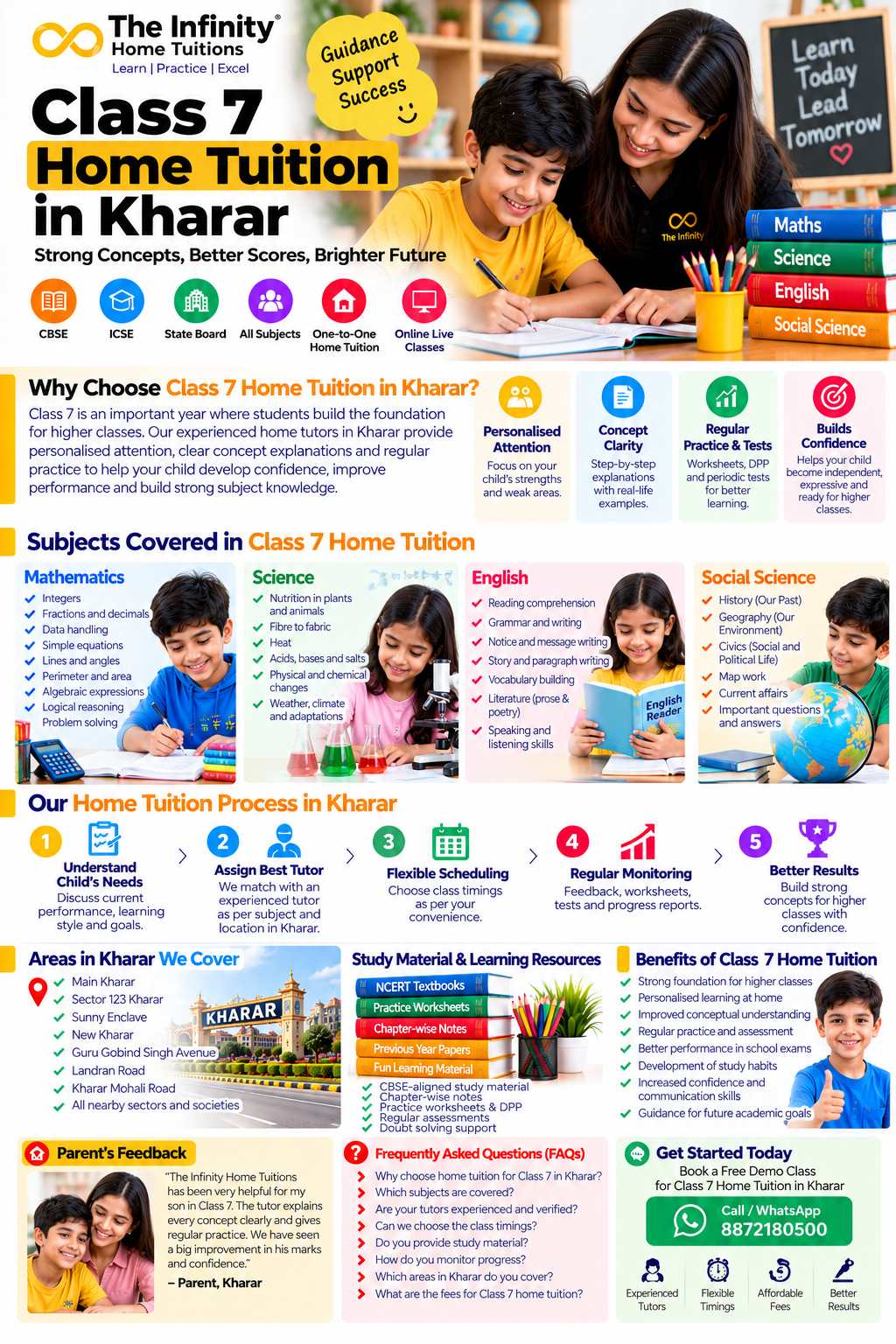
Looking for Class 7 home tuition in Kharar? The Infinity Home Tuitions welcomes enquiries from families looking for structured academic support in Mathematics, Science, English, Social Science, Hindi and other school subjects, subject to tutor availability. Lessons can be planned around the student’s board, school syllabus, learning goals and timetable. Class 7 is an important stage for moving from basic understanding to explaining concepts, solving multi-step questions and building independent study habits.
What Class 7 Home Tuition in Kharar Can Cover
Class 7 tuition can include concept teaching, textbook exercises, homework support, revision, practice questions and school-test preparation. The exact topics depend on the student’s board and school syllabus, so the tutor should use the prescribed textbook and current classroom work as the starting point. A good plan identifies which concepts are already secure and where the student needs more guided practice. Lessons should combine explanation, examples, independent attempts and feedback, helping the learner understand why a method works rather than memorise answers.
Why Class 7 Is an Important Academic Stage
Class 7 often brings more abstract concepts, longer written answers and problems that require several steps. Students may need to connect earlier knowledge with new topics in mathematics, science and humanities. Study habits also become more important as assignments and tests increase. A tutor can help learners organise notes, break tasks into manageable steps, review mistakes and plan revision before deadlines. The goal is to strengthen understanding and independence, not simply complete homework faster or promise a particular grade.
Class 7 Mathematics Home Tutor in Kharar
Mathematics topics may include integers, fractions, decimals, rational numbers, algebraic expressions, simple equations, lines and angles, triangles, comparing quantities, perimeter, area, data handling and practical geometry, depending on the curriculum. Check the school textbook for the exact chapter list. A tutor can model a method, explain why each step is valid and then give the student similar questions to solve independently. Encourage the learner to show working, check signs and units, and review whether the final answer is reasonable. Consistent practice helps reveal patterns in errors.
Integers, Fractions and Rational Numbers
When working with integers, students should understand number lines, positive and negative values, ordering and operations rather than rely only on sign rules. Fractions and rational numbers require careful attention to equivalent forms, common denominators and the meaning of each operation. Visual models can help connect the procedure to the concept. If a learner makes repeated errors, ask them to explain the step where the result changed. Then practise a small set of targeted questions before moving to mixed exercises. This builds accuracy and makes the method easier to transfer to unfamiliar problems.
Algebraic Expressions and Simple Equations
Algebra introduces symbols that represent numbers and relationships. Students should learn to identify terms, coefficients and variables as required by their syllabus, combine like terms and substitute values carefully. Simple equations are easier when the learner understands that both sides must remain balanced. A tutor can use worked examples, explain each transformation and then ask the student to justify the next step. Practise checking a solution by substituting it back into the original equation. Avoid teaching rules as isolated tricks; connect them to the underlying meaning.
Geometry, Angles, Perimeter and Area
Geometry lessons may cover lines, angles, triangles, properties of shapes, perimeter and area, depending on the curriculum. Diagrams should be neat and labelled so the student can identify the information provided. A tutor can demonstrate how to select a relevant property or formula, then guide the learner through a similar question. Students should include units in measurements and distinguish between perimeter and area. For construction-based topics, use the instruments and methods specified by the school. Accurate diagrams and organised working can prevent avoidable mistakes.
Class 7 Science Tuition in Kharar
Science learning may include nutrition, heat, acids and bases, physical and chemical changes, weather and climate, soil, respiration, transport, reproduction, motion and time, electricity or other topics depending on the board. The current textbook should determine the lesson plan. A tutor can help students connect definitions to examples, interpret diagrams, explain processes in sequence and answer questions in clear scientific language. Where activities or demonstrations are used, they should be safe and appropriate for the student’s age. Understanding cause and effect is more useful than memorising isolated lines.
Scientific Diagrams, Definitions and Experiments
Science answers often require precise terms, labelled diagrams and logical explanations. Students can practise defining a concept in their own words first, then refine it using the terminology expected by the textbook. Diagrams should be clear, correctly labelled and relevant to the question. For experiment-based topics, learn the aim, materials, method, observation and conclusion when these are part of the syllabus. Never attempt risky experiments at home. Reviewing why an observation supports a conclusion helps learners understand scientific reasoning and prepare more effectively for written assessments.
English Reading, Grammar and Writing
Class 7 English may include reading comprehension, vocabulary, grammar, literature, formal or informal writing, paragraphs, notices, letters and other formats prescribed by the school. Students should practise identifying the main idea, supporting details, tone and meaning from context. Writing lessons can focus on structure, relevant details, sentence variety, grammar and proofreading. A tutor can review a draft, explain the most important corrections and let the student revise independently. This is more effective than copying a model answer without understanding its structure.
Social Science: History, Geography and Civics
Social Science may combine historical events, geography, environment, government and civic life according to the student’s curriculum. Students benefit from timelines, maps, comparison tables and short summaries that show relationships between ideas. For a long-answer question, teach the learner to identify the command word, select relevant points and organise them logically. Geography answers may need map skills or correct terminology, while history often requires sequence and cause-and-effect explanation. The tutor should follow the prescribed textbook and avoid introducing unsupported facts that conflict with the course.
Hindi and Additional Language Support
Hindi or another language subject may require grammar, comprehension, literature, vocabulary, writing formats and accurate spelling. The tutor should work from the school text and assessment pattern. Encourage the student to explain a passage in their own words before drafting an answer. Grammar practice should include examples and opportunities to apply the rule in original sentences. For writing tasks, focus on relevance, clarity, structure and proofreading. Families should mention the language and board when enquiring so the teaching plan can match the actual course.
Homework, Notes and Independent Study Skills
Homework should help students practise concepts independently rather than simply reproduce completed examples. A tutor can explain a difficult instruction, demonstrate the first step and then let the learner finish the problem. Encourage concise notes with key terms, formulas, diagrams and examples, rather than copying entire pages. Students can keep a list of questions they could not solve and revisit them during revision. These habits help the learner become more organised and make tutoring sessions more focused. Parents can support by checking deadlines without taking over the work.
Test Preparation and Error Analysis
Effective test preparation begins before the night before an exam. Break the syllabus into topics, schedule short revision sessions and practise questions in the format used by the school. After a test or worksheet, classify errors: concept misunderstanding, forgotten fact, calculation slip, misread instruction or incomplete explanation. Each type requires a different response. For example, a concept gap needs re-teaching, while a careless arithmetic error may need checking routines. Timed practice can be introduced when the student understands the material. No tutor can guarantee a specific mark or rank.
Personalised One-to-One Tuition
One-to-one tuition allows the tutor to adjust pace and examples to the learner’s needs. A student who understands a concept orally but struggles to write it can practise structured answers; a learner who makes repeated algebra errors can work through each step and explain the reasoning. Sessions should include independent attempts so the tutor can see what the student can do without help. Regular feedback should identify strengths, current gaps and the next practical goal. The purpose is to build competence and independence, not make the student rely on prompts for every question.
Home Tuition Areas in Kharar
Families can enquire from Kharar and nearby localities such as Sunny Enclave, Sector 125, Sector 126, Landran Road and Khanpur. Availability depends on the exact location, subject, day, time and suitable tutor match, so mentioning an area does not guarantee immediate placement. Share the student’s board, subjects, locality, preferred timetable and main learning goals when contacting the team. If in-person lessons are not convenient, ask whether online one-to-one live classes may suit the student’s schedule and learning style.
How to Choose a Class 7 Tutor
Ask how the tutor diagnoses learning gaps, explains difficult concepts and checks whether the student can solve questions independently. Share recent test papers or textbook exercises that have been challenging. Discuss lesson frequency, duration, fees, scheduling, communication and cancellation expectations before starting. A suitable tutor should encourage questions and explain mistakes constructively, rather than relying only on memorisation or pressure. Confirm subject and board familiarity as part of the discussion. Tutor availability and fit depend on the student’s requirements, so clarify expectations before agreeing to a schedule.
A Weekly Study Plan for Class 7
A realistic weekly plan can include school homework, revision of current topics, practice of one difficult skill, reading or written-answer work and a short review of older material. Divide large tasks into smaller targets, such as solving five algebra questions or summarising one science process. Include breaks and protect time for sleep and activities. At the end of the week, identify which tasks were completed and what still needs help. Adjust the plan to actual school deadlines and the student’s workload rather than following a rigid timetable that quickly becomes unmanageable.
Worksheets, Practice Questions and Revision
Worksheets are most useful when they match the current syllabus and target a specific learning objective. Begin with questions that check understanding, then move to mixed or application-based problems. For mathematics, show complete working; for science, practise precise explanations; for English and Social Science, plan and proofread written answers. Review mistakes before attempting another large set. Students can maintain an error notebook with the question type, cause of the mistake and corrected method. This turns practice into a learning tool rather than just a score.
Home Tuition or Online Live Classes?
Home tuition may suit families who prefer an in-person tutor, subject to local availability. Online one-to-one live classes can be convenient when travel is difficult or the student is comfortable learning digitally. Online sessions work best with reliable internet, a quiet space and textbooks ready. Families can also ask about group live classes where suitable. Choose the format based on the student’s attention, timetable, subject and comfort. Explore the [Online Tuition page](https://theinfinityhometuitions.com/online-tuition/) for more information about learning options.
Study Resources and The Infinity App
The school textbook and teacher instructions should remain the primary reference for Class 7. Supplementary notes, quizzes, practice papers and revision resources can help when they match the prescribed course. The Infinity learning platform promotes resources such as courses, books, tests, quizzes, notes and lectures; availability may vary by course. Visit [TheInfinity.live](https://theinfinity.live/) for live learning and free study material, or [download The Infinity App](https://play.google.com/store/apps/details?id=com.dqawyh.ztmscp). Use extra material to reinforce understanding, not replace school requirements.
How Parents Can Support Class 7 Learning
Parents can help by providing a workable study environment, checking upcoming deadlines and asking the student to explain a concept in their own words. If a problem is difficult, ask what the learner has tried before giving a hint. This encourages independent thinking and helps identify the exact obstacle. Notice consistent effort, improved organisation and better explanations, not only marks. Share ongoing concerns with the tutor so the learning plan can be adjusted. Keep expectations realistic and avoid comparing the student with others; progress depends on several factors.
Frequently Asked Questions About Class 7 Tuition in Kharar
Do you accept Class 7 tuition enquiries in Kharar? Yes, enquiries are welcome; arrangements depend on suitable tutor availability. Which subjects can be covered? Families can ask about Maths, Science, English, Social Science, Hindi and other school subjects. Can lessons follow the school textbook? Yes, planning can be based on the curriculum shared by the family. Is online tuition possible? Online one-to-one live classes can be discussed. Can a tutor guarantee marks? No responsible provider can guarantee a specific score; outcomes depend on prior learning, attendance, practice and school assessment.
How to Enquire About Class 7 Home Tuition
Share the student’s class, board, subjects, Kharar locality, preferred schedule and learning goals. Mention upcoming tests and the topics that need attention. Use the [Book Demo page](https://theinfinityhometuitions.com/book-demo/) or contact The Infinity Home Tuitions through [WhatsApp at 8872180500](https://wa.me/918872180500). Tutor availability and final arrangements are confirmed after discussion. Explore [Subjects We Offer](https://theinfinityhometuitions.com/subjects-we-offer/) and [Online Tuition](https://theinfinityhometuitions.com/online-tuition/) for related options.
Official Curriculum and Useful Learning Links
Confirm the current board, textbook and syllabus with the school before using supplementary notes or sample papers. For CBSE academic information, visit the [official CBSE Academic website](https://www.cbseacademic.nic.in/). Families can also explore [Subjects We Offer](https://theinfinityhometuitions.com/subjects-we-offer/) and [Book Demo](https://theinfinityhometuitions.com/book-demo/). The most useful resource is one that matches the student’s class, subject and current course. Ask how additional practice supports the topics taught at school.
Preparing for the First Tuition Session
Before the first session, keep recent notebooks, textbook chapters, test papers and examples of difficult questions ready. Share the student’s learning goals and preferred schedule. This helps the tutor understand the starting point and choose relevant activities. After the session, ask the student which concept became clearer and what still needs practice. Keep feedback constructive and specific. A good first lesson should identify priorities and build a plan rather than try to cover too many chapters at once.
Tracking Progress and Setting Realistic Goals
Review progress through independent work, homework quality, practice accuracy and the student’s ability to explain concepts. Marks are one signal but do not show every change in understanding. If the same mistake keeps appearing, share an example with the tutor and agree on a specific next step. Set goals that can be checked, such as completing a question type accurately or improving the structure of a written answer. Keep expectations realistic and review the plan periodically. Consistent practice and attendance matter, but no particular score can be promised.
Enquire About Class 7 Home Tuition in Kharar
Share the student’s subjects, board, locality and preferred schedule to discuss suitable learning options.
Book a Demo Download The Infinity App WhatsApp 8872180500
Explore TheInfinity.live for live learning and free study material.