Class 1 Home Tuition in Kharar | The Infinity Home Tuitions
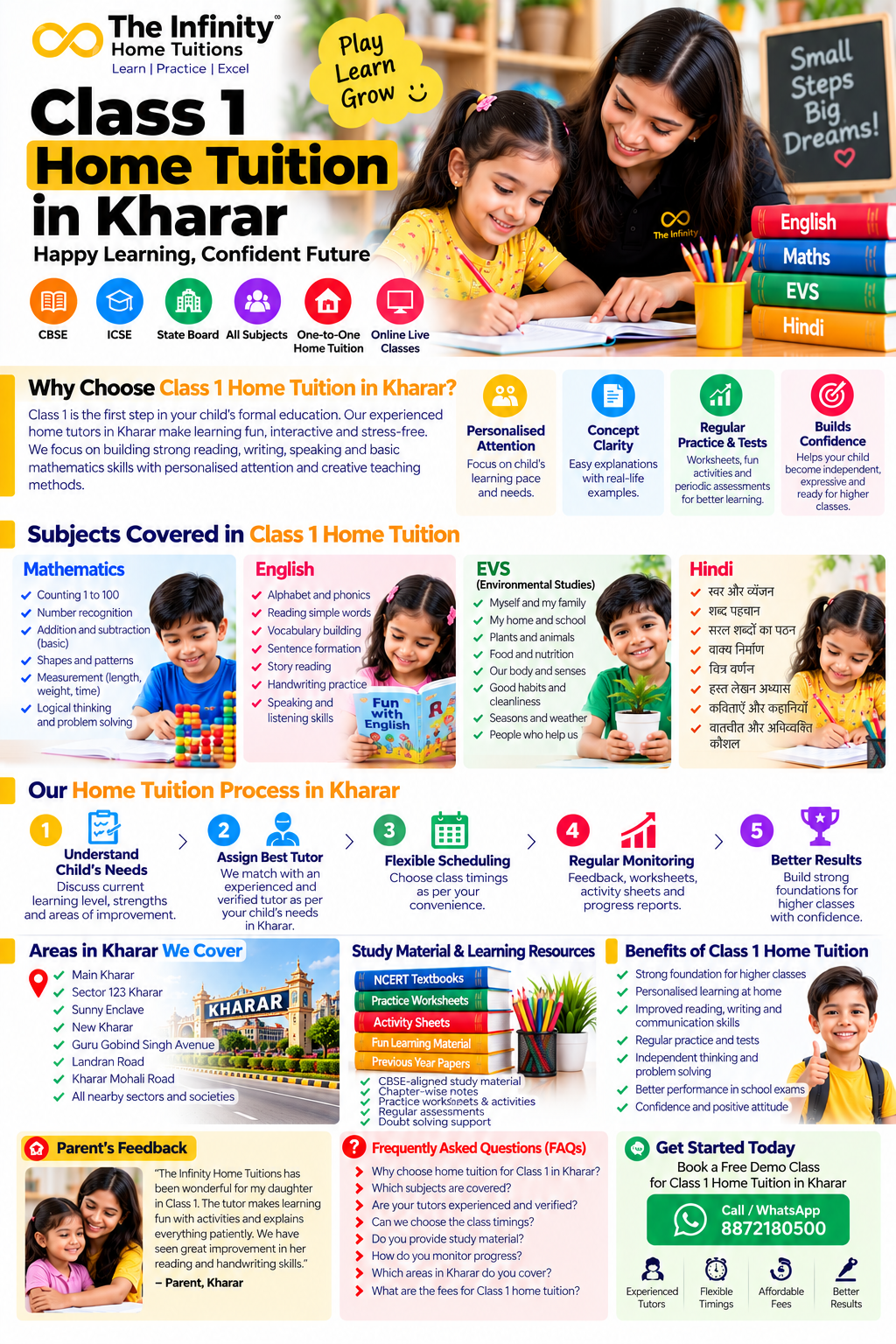
Looking for Class 1 home tuition in Kharar? The Infinity Home Tuitions welcomes enquiries for gentle, structured learning support in early reading, writing, mathematics, Hindi, English and other school subjects, subject to tutor availability. Lessons should follow the child’s school syllabus and learning pace, with short activities, repetition and encouragement. The aim is to help young learners build confidence, develop foundational skills and enjoy learning without unnecessary pressure.
Why Class 1 Home Tuition in Kharar Can Help
Class 1 is a major transition into formal schooling. Children begin to connect letters with sounds, read short words, write sentences and use numbers in different ways. Some learners need extra time with a skill; others benefit from revisiting instructions or practising in a quieter setting. Personalised tuition can provide that extra practice while staying aligned with schoolwork. A suitable tutor should be patient, use age-appropriate examples and give the child chances to answer independently. Learning should feel supportive, not like an extension of a long school day.
Early Reading and Phonics
Reading development may include recognising letters, connecting sounds to letters, blending simple sounds, reading familiar words and understanding short sentences. The exact approach should match the child’s school programme and language. A tutor can use picture cards, short books and sound games to practise without making the lesson feel like a test. Ask the child to sound out a word and then explain its meaning. If a skill remains difficult, repeat it in small steps rather than rushing to longer passages. Regular short practice is usually more manageable for young learners than a long worksheet.
English Writing, Spelling and Sentence Formation
Class 1 writing may include letter formation, spacing, spelling familiar words, completing sentences and writing simple ideas. Children need time to develop pencil control and organise words on a page. A tutor can model a letter or sentence, then let the child try independently. Feedback should be encouraging and specific: show one thing to improve at a time and allow another attempt. Reading aloud and writing short sentences about familiar topics can connect reading with writing. The school textbook and teacher instructions should guide which letters, words and sentence patterns are practised.
Hindi Reading and Writing Support
Hindi learning may include स्वर and व्यंजन recognition, मात्रा, simple words, reading short sentences and writing practice, depending on the child’s school syllabus. A tutor can use familiar vocabulary, picture prompts and short oral activities to help children connect sounds, letters and meanings. Written practice should be gradual, with attention to letter formation and मात्रा placement where relevant. Families should share the exact textbook and current chapters so lessons remain consistent with school expectations. For children learning another language, the same principle applies: follow the prescribed course and practise in manageable steps.
Class 1 Mathematics Home Tutor in Kharar
Early mathematics often includes counting, number recognition, comparing quantities, number order, addition, subtraction, shapes, patterns, time and money concepts, depending on the curriculum. Use the child’s textbook to confirm the exact topics. Objects, counters, number lines and drawings can help children see what numbers represent before moving to written sums. A tutor can ask the learner to explain how they counted or chose an answer. The aim is to develop number sense and confidence, not only memorise calculations. Short activities with familiar objects can make practice more engaging.
Counting, Addition and Subtraction
Counting becomes stronger when children connect number names, written numerals and actual quantities. Count objects in groups, compare which group has more and practise putting items together or taking them away. These activities introduce addition and subtraction in a concrete way. Once the child understands the idea, use simple written examples from the school syllabus. If a learner relies on guessing, return to objects or drawings and ask them to show the steps. Celebrate careful thinking and improvement rather than speed alone.
Shapes, Patterns, Time and Everyday Maths
Recognising shapes, continuing a pattern and talking about daily routines can build mathematical thinking. Use safe everyday examples such as identifying circles and rectangles, arranging objects by size or describing what happens before and after school. Time and money topics should follow the prescribed curriculum and be taught using age-appropriate examples. A tutor can encourage the child to describe the pattern or explain why one shape is different. These conversations build vocabulary and reasoning alongside mathematics.
EVS and Learning About the World
Environmental Studies or related primary topics may cover family, school, plants, animals, food, health, transport, weather and the local environment. The exact syllabus varies by school. Lessons can use pictures, simple observations and discussion to connect ideas with everyday life. A tutor might ask the child to describe a plant, identify healthy habits or explain how to stay safe while travelling. Activities should be age-appropriate and safe. The goal is to build curiosity and help children express what they observe in clear sentences.
Homework and School Routine Support
Homework can help children practise a skill after school, but it should remain manageable and age-appropriate. A tutor can explain the instruction, demonstrate the first example and then let the child try. If the learner gets stuck, identify the confusing step rather than completing the work on their behalf. Parents can support the routine by keeping books in one place, checking the school diary and setting a regular but short study time. Play, movement and rest remain important parts of a young child’s day.
How One-to-One Tuition Supports Young Learners
One-to-one lessons allow the tutor to adjust the pace, repeat instructions and choose examples that match the child’s interests. A learner who is unsure about a letter sound can practise it in different words; a child who understands counting can move on to simple comparisons. Lessons should include a mix of explanation, play-based practice and independent attempts. A tutor should not expect a young child to sit still for a long uninterrupted session. Short focused activities and positive interaction are more suitable for early primary learning.
Choosing a Suitable Class 1 Tutor
Ask how the tutor works with young children, builds foundational skills and keeps lessons age-appropriate. A suitable tutor should be patient, encourage questions and communicate clearly with parents about areas needing practice. Share the child’s current school topics, learning preferences and any upcoming assessments. Confirm schedule, lesson duration, fees, location and cancellation arrangements before starting. Tutor availability and suitability depend on the actual requirements, so clear communication is important. Avoid relying on promises of guaranteed marks; the priority is steady learning and confidence.
Home Tuition Areas in Kharar
Families can enquire from Kharar and nearby localities such as Sunny Enclave, Sector 125, Sector 126, Landran Road and Khanpur. Availability depends on the exact location, schedule, subject and suitable tutor match; mentioning an area does not guarantee immediate placement. When contacting the team, share the child’s class, board, subjects, locality and preferred timings. If in-person lessons are not convenient, ask whether online one-to-one live classes may suit the child’s age and attention span.
Home Tuition or Online Live Classes for Class 1?
In-person tuition may suit families who prefer face-to-face support, subject to local availability. Online learning can be considered when a child is comfortable using a device with an adult nearby, but young learners may need more hands-on guidance and shorter activities. A quiet space, reliable internet and parent support can help online sessions work better. Discuss the child’s attention, preferred format and learning needs before deciding. See the [Online Tuition page](https://theinfinityhometuitions.com/online-tuition/) for information about live learning options.
Study Resources and The Infinity Learning Platform
The child’s school textbook and teacher instructions should remain the main guide for Class 1. Supplementary worksheets, reading practice and simple quizzes can be helpful when they match the current curriculum and are not overwhelming. The Infinity platform promotes learning resources such as courses, books, tests, quizzes, notes and lectures; available features can vary by course. Visit [TheInfinity.live](https://theinfinity.live/) for live learning and free study material, or [download The Infinity App](https://play.google.com/store/apps/details?id=com.dqawyh.ztmscp). Choose resources suitable for the child’s age and current learning stage.
How Parents Can Encourage Learning at Home
Parents can support learning by reading together, talking about everyday objects, counting during routine activities and encouraging the child to explain what they learned. Keep practice short and positive. If the child makes a mistake, show how to try again without embarrassment. Notice effort, curiosity and willingness to practise rather than comparing the child with others. Maintain a balanced day with play, rest and school responsibilities. Share persistent difficulties with the tutor so the learning plan can be adjusted in a supportive way.
Frequently Asked Questions About Class 1 Tuition in Kharar
Do you accept Class 1 tuition enquiries in Kharar? Yes, enquiries are welcome and suitable arrangements depend on tutor availability. Which subjects can be covered? Families can ask about English, Hindi, Maths, EVS and other school subjects. Can tuition follow the school textbook? Lessons can be planned around the textbook and current topics shared by the family. Is online tuition available? Online one-to-one live learning can be discussed based on the child’s needs. Can a tutor guarantee marks? No specific score can responsibly be guaranteed; progress depends on practice, attendance, prior learning and school assessment.
How to Enquire About Class 1 Home Tuition
Share the child’s class, board, subjects, Kharar locality, preferred schedule and current learning goals. Mention whether you prefer home tuition or online learning and include any topics that need extra practice. Use the [Book Demo page](https://theinfinityhometuitions.com/book-demo/) or contact The Infinity Home Tuitions through [WhatsApp at 8872180500](https://wa.me/918872180500). Tutor availability and final arrangements are confirmed after discussion. Browse [Subjects We Offer](https://theinfinityhometuitions.com/subjects-we-offer/) and [Online Tuition](https://theinfinityhometuitions.com/online-tuition/) for related options.
Official Curriculum and Learning Resources
Confirm the current curriculum and prescribed textbook with the school before using supplementary worksheets or sample material. For CBSE academic information, visit the [official CBSE Academic website](https://www.cbseacademic.nic.in/). Families can also explore [Subjects We Offer](https://theinfinityhometuitions.com/subjects-we-offer/) and [Book Demo](https://theinfinityhometuitions.com/book-demo/). The most useful resource is one that matches the child’s class, language and current schoolwork. Ask the tutor how additional activities support the topics being taught in class.
Preparing for the First Lesson
Before the first session, keep the child’s school books, notebook, school diary and recent assignments ready. Share the topics the child enjoys and the skills that feel difficult, such as reading a word, writing a sentence or solving a simple sum. This helps the tutor begin at an appropriate level. After the session, ask the child to show one thing they practised and tell you how it went. Keep the discussion encouraging and brief. A good start is based on understanding the child rather than rushing through many pages.
Tracking Progress Without Pressure
Review progress by noticing what the child can do independently, such as recognising more words, writing more clearly, counting accurately or explaining an idea. Marks are only one signal and may not show every improvement. If a difficulty continues, share a specific example with the tutor and agree on a small practice goal. Keep expectations realistic and avoid comparing the child with classmates. Consistent practice, attendance, school instruction and the child’s starting point all affect progress. The aim is steady skill development and a positive relationship with learning.
Enquire About Class 1 Home Tuition in Kharar
Share the child’s subjects, board, locality and preferred schedule to discuss suitable learning options.
Book a Demo Download The Infinity App WhatsApp 8872180500
Explore TheInfinity.live for live learning and free study material.
Creating a Child-Friendly Learning Space
Choose a quiet, comfortable place with good lighting and the books needed for the lesson. Keep pencils, crayons, counters or picture cards nearby if they support the activity, but avoid filling the table with distractions. Short sessions with a clear purpose are easier for young learners to follow. A simple plan might be a reading activity, a short writing task and a few number questions, with movement breaks as needed. The tutor and parent should adjust the pace to the child’s attention and energy rather than expecting every lesson to look the same.
A Balanced Approach to Screen Time and Online Lessons
If the family considers online classes, an adult should help the child join the session, open the right materials and stay safe online. Keep the device in a shared family space and use age-appropriate learning activities. Young children may need printed worksheets, objects or drawing alongside the screen to stay engaged. Online tuition is not automatically suitable for every child; consider attention span, comfort with the device, internet reliability and the tutor’s approach before deciding. For in-person tuition, prepare the same books and a quiet place so lesson time can be used effectively.
Working Together with the School
Tutoring works best when it complements what the child is learning in school. Share current chapters, homework instructions and teacher feedback where available, and let the tutor know if the school changes the pace or assessment schedule. Avoid asking the tutor to teach several unrelated topics at once; prioritise the skills that matter most for the child’s current learning stage. Regular, calm communication between parent and tutor can help identify progress and decide what to practise next. The goal is to support the child, not create competing routines or unnecessary workload.